


Quick Summary:
AI data governance is the set of policies and controls that keep the data flowing into and out of AI agents reliable, auditable, and permissioned. This guide walks through how ScriptsHub Technologies helped a regulated financial-services team close the two gaps that surface once agents reach production: blind data lineage and over-permissioned agent identities. You will see the runtime lineage capture and the least-privilege access control we deployed, the NIST- and OWASP-aligned AI governance framework we mapped them to, the validation results, and a step-by-step path to enterprise AI governance for your own agent stack.
What Is AI Data Governance for AI Agents?
AI data governance for AI agents is the discipline of managing the availability, data quality, lineage, and security of the data that AI systems read and write. It extends that discipline to autonomous agents that act without a human reviewing every step. For a traditional dashboard, governance answers a slow question: who can query this table? For an AI agent, the same question turns real-time and recursive. The agent decides what to retrieve, calls tools, writes new artifacts, and chains those actions faster than any review queue can keep up.
An analyst might download one file, edit it, and upload a version. An agent can read hundreds of records, summarize each, and generate dozens of new files in minutes, and if any of those land in an unsecured location, you have a compliance exposure at machine speed. Strong data governance for AI closes that gap by making every read and write observable and permissioned at the moment it happens.
Why AI Agents Break Traditional Data Governance
Static governance was built for predictable, centralized data and human users who log in, act, and log out. AI agents violate those assumptions at once. They hold non-human identities that rarely map to a person, they operate continuously rather than in sessions, and they can be steered by the content they read through prompt injection. The OWASP Top 10 for LLM Applications names two of the resulting risks directly. Excessive Agency is when an agent gets more tools or permissions than its task needs. Sensitive Information Disclosure is when data leaks through its output. The exposure is already measurable: IBM’s 2025 Cost of a Data Breach Report found that 97% of organizations hit by an AI-related breach lacked proper AI access controls, and 63% had no AI governance policy.
The symptom our financial-services client reported was familiar. Their retrieval agents worked in the demo and stalled in the security review. Nobody could prove which datasets an agent had actually touched to answer a given question, and every agent shared one broad service account with read access far wider than any single task needed. Those are the two failure modes that block most agent deployments: invisible data lineage and coarse data access control.
The Diagnosis: Blind Lineage and Over-Permissioned Agents
When ScriptsHub Technologies audited the stack, our data engineering team separated “what the agent could reach” from “what the agent did reach.” The first was documented in an IAM policy. The second existed nowhere. Catalog tools captured pipeline-level movement between tables. But the agent’s runtime retrieval – the specific rows and documents pulled into a context window at answer time – left no trail. Under GDPR and SOX audit scrutiny, auditors could not reconstruct the data behind a March decision, and the team could not scope permissions down because they had no evidence of what each agent genuinely used.
On the access side, a single high-privilege identity served every agent. A prompt-injection payload in one document could then steer any agent toward data it had no business reading. OWASP’s guidance is explicit here: authorization should be enforced in external systems rather than delegated to the model, and agents should run in a scoped identity rather than a generic high-privileged one.
How to Secure Data Lineage for AI Agents
The fix is to capture data lineage at the agent boundary: recording what the agent actually accessed at runtime, not just what the pipeline could move. We wrapped every agent tool call so that each retrieval emits a lineage event recording the identity, the dataset, the classification, and the purpose. Routing all reads and writes through one observable layer turns an opaque agent into an auditable one.
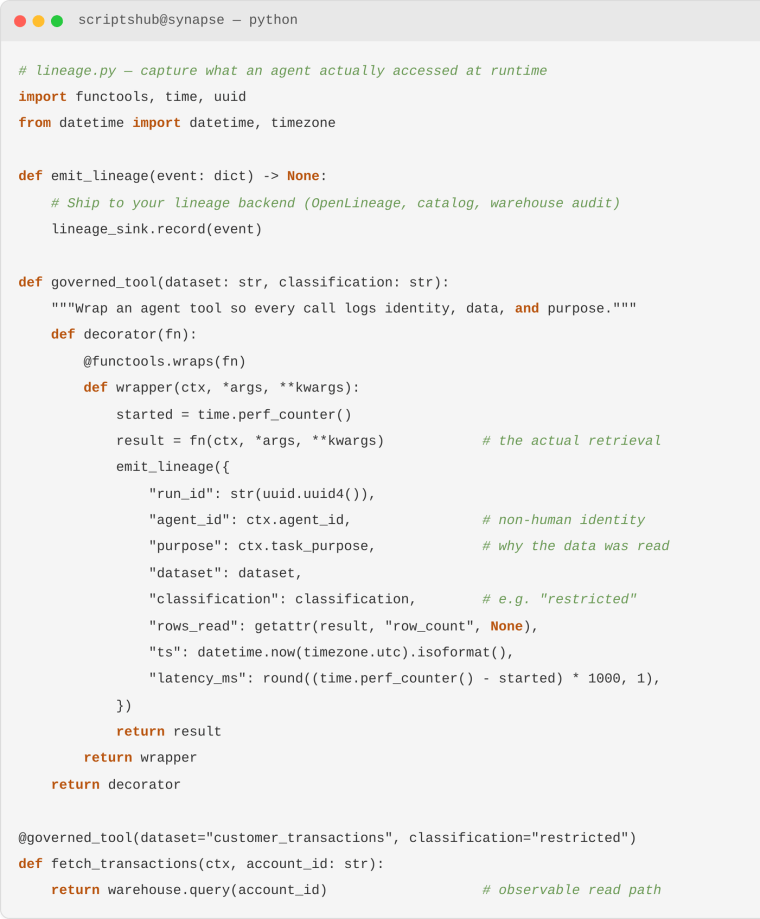

Why this works: Because the lineage event fires inside the tool call, it records the real rows and documents that entered the context window. That is exactly the evidence auditors ask for when they reconstruct a past decision. It also feeds the access layer: once you can see what each agent truly uses, you can scope its permissions down to that set with confidence.
How to Enforce Data Access Control for AI Agents
Data access control for agents means giving every agent its own scoped, non-human identity and checking each request against an external policy before any data is returned. The check evaluates the agent’s identity, the sensitivity of the data, and the stated purpose, and it lives outside the model so a manipulated prompt cannot talk its way past it. This is least privilege applied to AI agents, and it is the runtime expression of a zero trust architecture: no request is trusted because of where it comes from, and every request is verified.
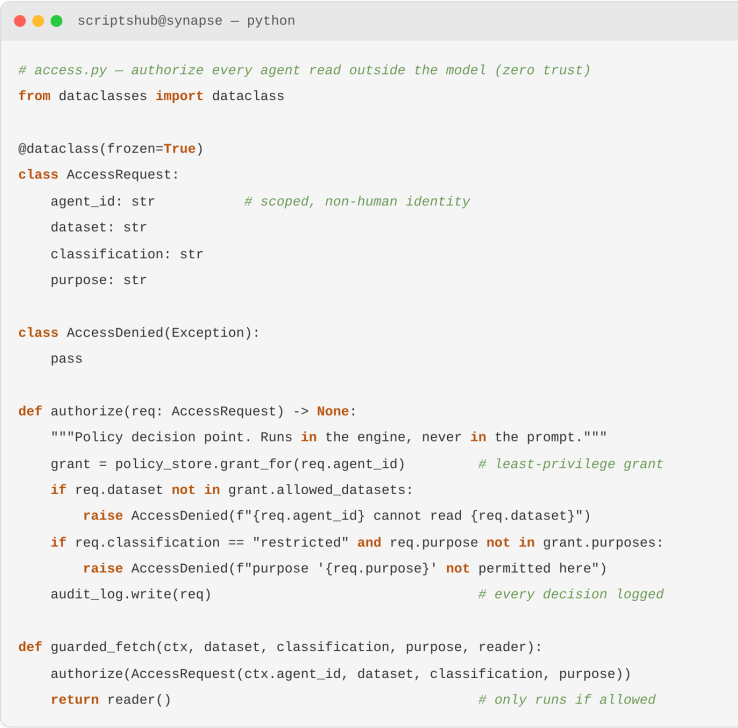

Why this works:Because authorization happens in the policy engine and not in the prompt, an injected instruction cannot escalate the agent’s reach. The worst it can do is request data the identity was never granted, which the gate denies and logs. Pairing scoped identities with the lineage feed also makes access reviews continuous instead of quarterly, since revoked or unused grants surface automatically.
If your agents are stalling at the same security gate, ScriptsHub Technologies runs a focused AI governance assessment that maps your lineage and access gaps to a remediation plan. Our AI development services team has shipped these controls into regulated production environments, and our AI consulting practice can pressure-test your agent architecture before it reaches your auditors.
An AI Governance Framework: NIST, OWASP, and Zero Trust


Point fixes hold only when they sit inside a framework. We anchored the client’s program to three references so security, legal, and engineering shared one vocabulary. The NIST AI Risk Management Framework supplied the operating rhythm. Its four core functions – Govern, Map, Measure, and Manage – turn governance from a one-time sign-off into a continuous lifecycle.
The OWASP GenAI Security Project supplied the threat model, naming the agent-specific AI security risks the controls had to answer. NIST’s zero trust architecture supplied the access principle, moving trust from network location to verified identity. The AI RMF Playbook then translated each function into concrete actions the team could assign and track.
This is where an AI governance framework earns its keep for enterprise buyers. It converts a pile of controls into an auditable story: here is the risk we mapped, here is the control we deployed, here is the measurement that proves it works. That narrative is what shortens security reviews and procurement questionnaires, and it is the same discipline our model engineering practice applies across the wider machine learning lifecycle.
Validation: Measuring AI Data Governance Gains
We validated the rollout on the client’s priority pipelines before extending it. The table below shows the shift, with figures kept to what we measured on the first two agent workflows rather than the whole estate.
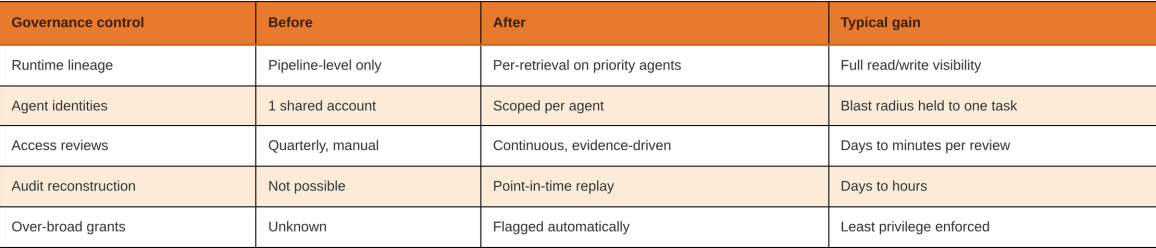

The agents cleared the security review they had failed twice, and the team could answer “what data informed this output” without a fire drill.
How to Implement Enterprise AI Governance
Enterprise AI governance lands fastest when you pilot it on one workflow with a clear metric. First, inventory your agents and the data each one can reach, and separate that from what it actually reaches. Second, route every agent read and write through one observable layer so lineage is captured at runtime. Third, issue each agent a scoped, non-human identity and move authorization into an external policy engine. Fourth, map the whole program to the NIST functions and the OWASP risk list so every control traces to a named risk. Fifth, measure a small set of signals such as lineage coverage, access-review time, and audit-reconstruction time, then extend the pattern to the next workflow once the pilot holds. Starting narrow is what gets AI data governance shipped as a working capability, and it is the approach we bring across our services.
Conclusion
AI data governance is becoming the gate every agent must pass before it reaches production, and the two controls that open it are runtime data lineage and least-privilege access control, wrapped in a framework auditors recognize. Build them in early and governance becomes an accelerator instead of a blocker.
ScriptsHub Technologies helps enterprises across the US, UK, and India design and ship governed AI agents, from lineage instrumentation to zero-trust access. Talk to our team about an AI governance assessment for your agent stack. Contact ScriptsHub Technologies.
Frequently Asked Questions
Q. What is AI data governance for AI agents?
AI data governance is the set of policies and controls that keep the data agents read and write accurate, traceable, and access-controlled. For agents it must operate at runtime, governing each retrieval and action as it happens.
Q. How is AI data governance different from AI governance?
AI governance is the broad discipline covering models, fairness, and outcomes. The data-focused slice governs what agents read and write: where it came from, who may reach it, and whether an auditor can replay it.
Q. How do you track data lineage for AI agents?
Route every agent read and write through one observable layer and emit a lineage event on each tool call, recording identity, dataset, classification, and purpose. That captures what the agent actually accessed, not just what it could.
Q. How do you control data access for AI agents?
Use scoped, non-human identities per agent and enforce authorization in an external policy engine, not the prompt. Check identity, data sensitivity, and purpose on every request so injected instructions cannot escalate access.
Q. Which frameworks apply to governing AI agents?
Use the NIST AI Risk Management Framework for lifecycle governance, the OWASP Top 10 for LLM Applications for the agent threat model, and NIST zero trust architecture for identity-based access control.
Q. Does governance slow down agent deployment?
No. Governance built in during development shortens security reviews and procurement, because you can prove what data an agent used and that access is least-privilege. Most delays come from retrofitting it afterwards.