


QUICK SUMMARY
AI agent reliability usually breaks at the tool layer, not the model. A production pipeline ran green for 9 days while entire categories vanished from reports, and no exception fired. A minor-version upgrade had changed how tool schemas were generated for function calling, serializing arrays into strings. ScriptsHub Technologies pinned every generated schema as a build-time contract test, added output completeness checks, and gated framework upgrades behind a canary. Detection time fell from 9 days to 8 minutes.
Key Takeaways
- AI Agent Reliability and tool schema drift: Tool schema drift is an unannounced change to the JSON Schema defining an agent’s tool inputs and outputs, usually triggered by a framework or provider upgrade.
- AI Agent Reliability and monitoring: Monitoring misses tool schema drift because the call returns HTTP 200 and valid JSON, so nothing raises.
- AI Agent Reliability and contract tests: Contract tests pin each generated tool schema as a snapshot and fail the build when its shape changes.
- AI Agent Reliability and completeness invariants: Completeness invariants validate output using category coverage, row-count floors, and control-total reconciliation.
- Measured result: Report completeness improved from 78% to 99.6%, while detection time fell from 9 days to 8 minutes.
If your AI pipeline reports success, your dashboards stay green, and a stakeholder asks why a category disappeared from last week’s report, you have an AI Agent Reliability problem at the tool layer. Nothing crashed because nothing was built to crash: the contract between the agent and its tools changed shape, and nothing was watching it. AI Agent Reliability depends on catching these silent tool schema changes before they turn valid-looking outputs into missing data.
A logistics analytics team brought this to ScriptsHub Technologies after a VP’s report stopped reconciling. Reports still generated and looked complete, while missing whole categories of data.
What Is AI Agent Reliability?
AI agent reliability is the probability that an agent completes a task correctly and without unintended side effects, measured across repeated runs rather than one benchmark score. Princeton researchers decompose it into four dimensions – consistency, robustness, predictability and safety – in Towards a Science of AI Agent Reliability (arXiv:2602.16666, 2026), finding that recent capability gains produced only modest reliability improvement.
The arithmetic makes it urgent. Per-step accuracy compounds: an agent 90% reliable at each step of a twenty-step workflow finishes correctly about 12% of the time – a property of the weakest link, not an average.
Failures cluster in three places: non-deterministic planning, where identical inputs produce different tool choices; missing state recovery, where a mid-task error cannot resume; and the tool contract layer, where the interface an agent calls stops matching the one it was handed. This post covers the third – least discussed, and the most common cause of output that looks right and is not.
What Is Tool Schema Drift?
Tool schema drift is an unannounced change to the JSON Schema defining a tool’s inputs and outputs, when a framework, model provider, or connector upgrade regenerates it in a shape your pipeline never agreed to. The schema stays syntactically valid, so validators pass and no exception surfaces.
An ordinary integration failure throws a traceable error. Schema drift produces output close enough to pass a superficial check and wrong enough to corrupt the result: ["sales", "marketing"] serialized as "sales,marketing", the consumer reading only the first value, half the data gone.
Why this matters: Tool schemas are generated by the framework, not written by an engineer, so they never pass code review. A file nobody wrote is one nobody diffs.
How a Routine Upgrade Broke Our Tool Schemas in Production
The trigger was a minor-version bump of the orchestration framework, shipped straight to production. The release notes mentioned improved schema generation – accurate, and the problem.
Two tool schema failures ran in parallel. Some calls were rejected by the model API, then retried into a degraded path returning partial results. Others passed validation and still dropped fields: an array of categories flattened into a comma-joined string, a type declaration missing from a nested property.
The drift ran undetected for 9 days, because the model was fine, the sources were intact, and every component reported healthy. The first signal came from an analyst reconciling totals by hand; root-causing it from there took another week.


Figure 1: The same tool call on two paths. A pinned contract fails the build before the call happens; an unpinned one ships valid-looking JSON that drops fields downstream.
Why this works: The snapshot catches any shape change, including ones you did not anticipate – which is the whole category of drift. The strictness assertion is the second half: every major provider requires the same two constraints before it will guarantee that generated arguments match your schema.
Why Doesn’t Monitoring Catch AI Agent Reliability Failures?
Because conventional observability counts exceptions, and this failure rarely produces one. Rate limits and timeouts throw and hit dashboards. A schema that serializes an array into a string returns HTTP 200 and valid JSON.
IBM Research, in Detecting Silent Failures in Multi-Agentic AI Trajectories (arXiv:2511.04032), characterizes these silent failures as drift, cycles, and missing output detail occurring without clear error signals. Detecting them needed trajectory evaluation, not exceptions.
The root cause was structural. Tool schemas were generated dynamically and trusted implicitly, no regression test pinned their shape, no invariant checked completeness, and upgrades reached production ungated. Each gap is defensible; together they guarantee drift ships silently – a pattern we have seen across several production AI systems.
How Do You Contract-Test Tool Schemas Before They Reach Production?
Snapshot every generated tool schema, commit it, and assert it on each build, so drift fails the build with a readable diff.

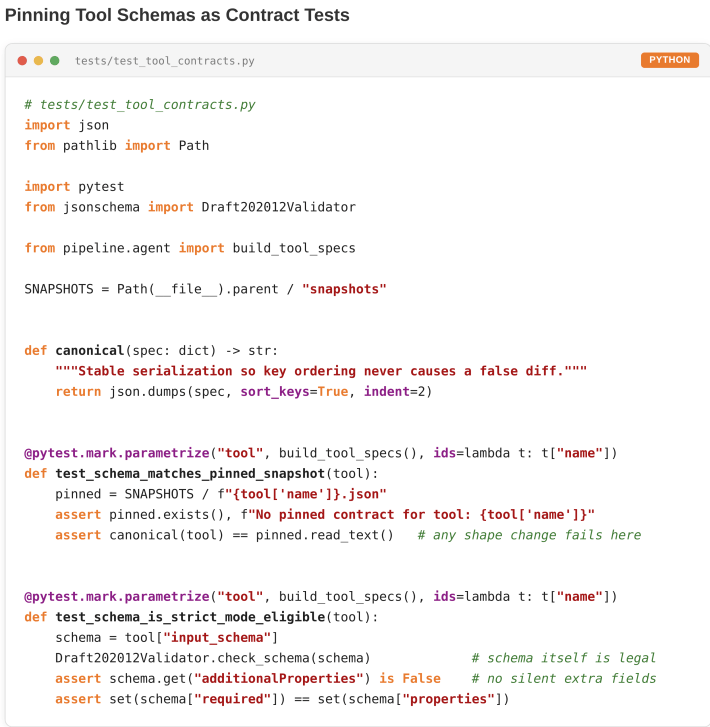
Figure 2: Every generated tool schema is pinned to a committed snapshot and checked for strict-mode eligibility on each build.
Why this works: The snapshot catches any shape change, including ones you did not anticipate – which is the whole category of drift. The strictness assertion is the second half: every major provider requires the same two constraints before it will guarantee that generated arguments match your schema.


A schema that cannot satisfy these cannot run in strict mode, so the assertion doubles as a portability check.
Tooling makes this cheap: snapshots come free with syrupy, and JSON Schema validation slots into the same suite via pytest-jsonschema. We pinned framework and model versions and gated upgrades behind a canary running that suite, applying semantic versioning discipline so no minor bump is assumed safe. Replaying the incident, the suite caught the drift in under a minute.
How to verify it works: Edit one property type in a tool definition and run the suite. If the build stays green, the snapshot is stale or the tool unregistered.
How Do You Catch Missing Data When No Error Fires?
Assert on the output, not the exit code. The snapshot protects the interface; a completeness invariant protects the result. Both are needed: a schema can be correct while the data is short.

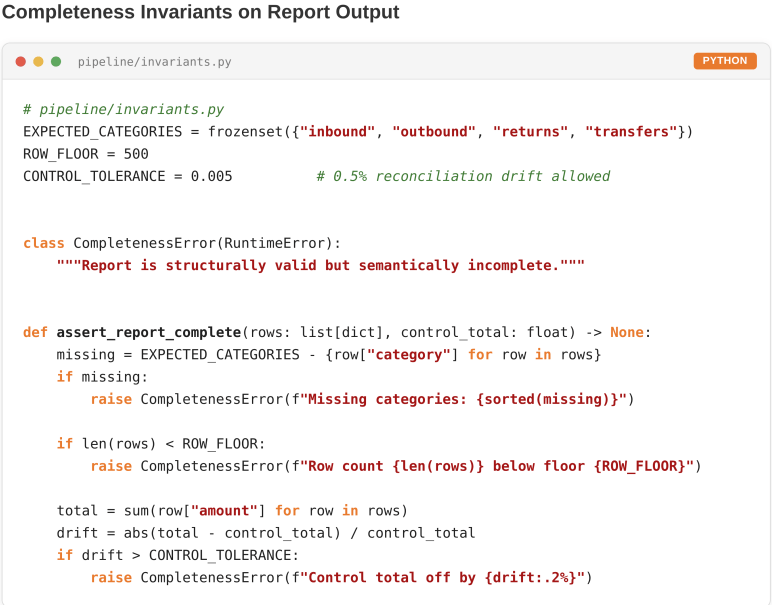
Figure 3: Three invariants run against the finished report – category coverage, a row-count floor, and control-total reconciliation.
Why this works: Each check catches a different failure. Category coverage catches the dropped-array case. The row floor catches truncation that keeps every category but loses volume. Control-total reconciliation catches the case where structure and counts look right and values are wrong.
We replaced the degraded-retry path with structured errors that page on-call. A fallback returning partial data is worse than an outage, which is visible.
When to use which: Snapshot assertions belong in CI, where they cost seconds and block a merge. Output checks belong at runtime. Either alone leaves half the failure surface open.
If your AI pipeline generates reports leadership acts on and nothing asserts the output is complete, that is worth an hour of review. Our AI consulting team audits pipelines and tells you which layers your setup justifies — including when one is enough.
Which Pipelines Actually Need This Protection?
Not every pipeline needs all of it. The deciding factor is whether the tool contract can change without your team’s approval.


The pattern is consistent: the further a schema’s author sits from your release process, the more layers you need. A hand-written schema with pinned dependencies is low-drift; a framework-generated one on a floating version is not.
Building any one of these layers is a sprint. What gets hard is scale: a schema registry spanning dozens of tools needs an owner and a review path, canary infrastructure needs traffic shadowing and a rollback story, and setting completeness invariants means agreeing what “complete” means for each report – a domain question, not an engineering one. The code here is the easy part. Knowing which layers a given pipeline earns, and which it does not, is the part that takes having done it before.
Limits of This Design: What Snapshot Assertions Cannot Catch
Snapshot assertions catch structural change, not semantic change, where the schema is byte-identical and the meaning of the values has moved. If a tool starts returning weights in pounds instead of kilograms, every assertion passes and the reports fill with valid nonsense.
Catching that needs distribution monitoring – the limitation we also hit handling schema drift in Azure Data Factory at the data layer.
Two honest costs. Snapshot tests generate maintenance: every intentional change needs a deliberate update, and a team that runs the update flag without reading the diff has rebuilt the original problem. The gate covers only registered tools, so one added without a snapshot stays invisible – hence a registry check.
Results: What Changed After Hardening the Tool Layer
Across the 60 days after implementation, report completeness – the share of published reports passing every invariant – went from 78% to 99.6%, a gain of 21.6 points. Tool-call contract coverage went from none to complete, and detection time from 9 days to 8 minutes. There were no silent data-loss incidents in those 60 days, against a prior run rate of 4 per quarter. These are one engagement’s numbers; yours will vary with pipeline complexity and how much instrumentation you start with.


Figure 4: 60-day outcomes after contract-testing the tool layer. Lower is better for silent data-loss incidents.
No better model and no framework migration was involved. The gain came from treating the tool layer as production code – the discipline our data analytics services apply to any decision-driving pipeline.
Conclusion: AI Agent Reliability Is an Integration Problem
AI agent reliability is mostly not a model-quality question, and the model engineering work teams reach for first rarely moves it. The model can be accurate and the data intact while the contract between them shifts unannounced. Contract tests, output invariants, version gating, and structured errors catch that movement – none of which need quantization or distillation, or a single retrained weight.
The useful question: if half a report’s data vanished tomorrow, what notices first – a monitor, or a VP three reports later?
Talk to us about your pipeline
If you are running agents with tool calls in production, the build is rarely the problem -the registry, the canary and the per-report invariants are. Schedule a consultation with ScriptsHub Technologies. We audit pipelines, pin contracts where warranted, and say plainly when your current design is sufficient.
Frequently Asked Questions
Q. What causes AI agent reliability failures in production?
Most come from drift in the tool schema: an unannounced change to the JSON Schema defining an agent’s tool inputs or outputs after a framework upgrade. The schema stays valid, so nothing alerts.
Q. Why do AI pipelines fail silently after a framework upgrade?
Because generated tool schemas are trusted without regression tests. An upgrade can reshape a schema into something still valid, so calls succeed while dropping fields. Nothing throws.
Q. How do I test AI agent tool schemas for drift?
Snapshot each generated schema to a committed file and assert it on every build. Add a strictness check requiring additionalProperties: false with all properties declared, as strict function calling requires.
Q. What is the difference between schema drift and tool schema drift?
Schema drift describes structural change in a data source, such as a renamed column. The tool-layer form is the same change in the function-calling contract between an agent and its tools.
Q. Why do AI agents fail more as workflows get longer?
Per-step accuracy compounds. An agent 90% reliable at each step completes a twenty-step workflow correctly about 12% of the time, so reliability is engineered per step, not averaged.
Q. Can output validation alone prevent silent data loss?
No. Output validation confirms a response is well formed, not that it is complete. Preventing silent data loss needs completeness invariants: category coverage, row-count floors, and control-total reconciliation.
Q. Does strict mode remove the need for contract tests?
No. Strict function calling guarantees arguments match the schema you supply. It cannot tell you that schema changed shape between releases, which is what the snapshot suite catches.