


QUICK SUMMARY
A vibe-coded app is production-ready when its failure modes are bounded and observable – not when the interface looks finished. These apps buckle under real traffic because AI assistants ship the happy path: working features fast, but no secrets management, authorization, error handling, or observability. This playbook covers the seven steps the ScriptsHub Technologies team uses to take a Lovable, Cursor, Bolt, v0, or Replit MVP to production without a rewrite. Engagements typically run three to six weeks.
When Your Vibe-Coded App Starts Falling Apart
Auth that fails silently. API keys in plaintext in your client bundle. A support queue growing faster than your team can clear it. If that’s your vibe-coded MVP under real users and you’re trying to Harden a Vibe-Coded App, the AI tool that built it isn’t the culprit – what got skipped on the way to production is.
A B2B SaaS founder came to ScriptsHub Technologies four months after shipping an MVP built with Cursor, Lovable, and Supabase. It worked; he had about 200 paying users. Then six weeks of growth split the seams, because nobody had hardened code the founder hadn’t written. Here’s the playbook that got it production-ready.
What “Production-Ready” Really Means for a Vibe-Coded App
A vibe-coded app is production-ready when its failure modes are bounded and observable, not when its screens look polished. To harden a vibe-coded app is to close the gap between a working demo and a real product: the demo runs the happy path; the product withstands concurrent users, hostile input, partial failures, and edge cases no AI pictured – and flags the moment something breaks.
The research is blunt. Veracode’s 2025 GenAI Code Security Report tested 100+ large language models across 80 coding tasks and found 45% of AI-generated samples introduced OWASP Top 10 vulnerabilities. Aikido Security’s 2026 report found AI-generated code is now the root cause of roughly 1 in 5 enterprise breaches – these tools optimize for the happy path, not production resilience.
Why Vibe-Coded Apps Fail in Production: 4 Recurring Failure Modes
Across every vibe-coded codebase we’ve hardened, the failures cluster into four:
- Secrets in the wrong place. API keys, database URLs, and OAuth secrets get written into source files so the AI has working examples. A few commits later, they’re in Git history forever.
- Auth enforced only in the browser. The UI hides admin buttons from non-admins, but the API behind them serves any authenticated request. IDOR (Insecure Direct Object Reference) bugs are everywhere.
- No error handling on outbound calls. Every third-party request – Stripe, SendGrid, OpenAI, Supabase – assumes success. A partial outage corrupts data quietly instead of failing visibly.
- No observability. The app breaks for a user; the team finds out from a support ticket two days later. No error tracking, no uptime monitoring, no searchable logs.
These four gaps drive the playbook below, closed in sequence – plus the operational habits (validation, CI, E2E tests) that keep them closed at scale.
The 7-Step Vibe-Coded App Hardening Playbook
Step 1: Audit and Rotate Every Secret in the Code and Git History
AI coding tools inline API keys, connection strings, and JWT secrets so code runs out of the box. Even after they move into environment variables, the originals stay in Git history – making secrets rotation, not deletion, the first hardening step. Our first sweep found 14 secrets, including a Supabase service role key.


Why this works: A secret pulled from the current file is still reachable in history, where attackers scan for exposed credentials.
Step 2: Move Authentication and Authorization to the API Layer
Frontend-only auth isn’t auth. Every endpoint that returns or changes data must independently verify the caller’s identity and permission. We found 23 endpoints trusting the frontend – three exposed cross-tenant data, letting any user pull another tenant’s records by changing an ID in the URL.
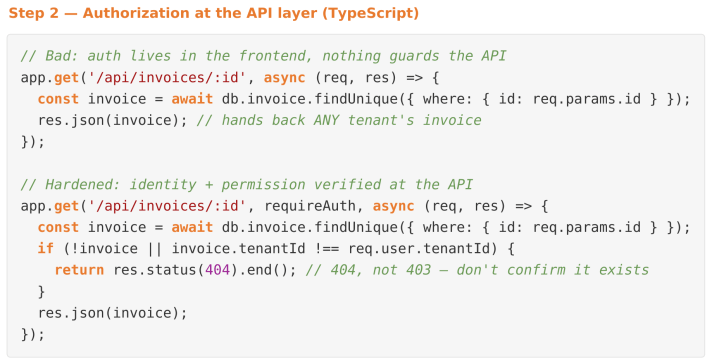

Why this works: The frontend is untrusted code; anyone with dev tools can call any endpoint directly. Authorization has to live where the data lives.
Step 3: Wrap Every External Service Call in Structured Error Handling
AI-generated code defaults to hopeful try { await fetch(...) } blocks with no fallback. Every external dependency fails eventually, and silent failures corrupt data instead of halting work. (See our guide to handling external API timeouts in Node.js.)


Why this works: Every external call can succeed, fail known (timeout, 4xx, 5xx), or fail unknown. AI code handles only the first; the dead-letter queue recovers the third.
Step 4: Add Input Validation and Rate Limiting to Every Public Endpoint
Vibe-coded apps rarely validate input or rate-limit. The SaaS MVP exposed /api/signup to unlimited POSTs, and a bot was mass-registering junk accounts unnoticed. A boundary schema validator plus a Redis rate limiter closed the gap in an afternoon.


Why this works: Validation at the boundary collapses a cluster of OWASP Top 10 bugs – SQL injection, XSS, type confusion – into one rejected request. Rate limiting turns abuse into an alertable signal.
Step 5: Stand Up a CI Pipeline That Runs on Every Push
A CI pipeline that lints, type-checks, scans dependencies, and runs tests on every push is the highest-leverage move in any hardening engagement: an afternoon to set up, regressions caught for the codebase’s lifetime. The minimum runs four jobs – lint, typecheck, test, and dependency audit (npm audit or pip-audit).
Why this works: AI-assisted developers commit 3 to 4 times faster than non-AI peers, per Apiiro’s Fortune 50 research – and monthly security findings climbed from roughly 1,000 to over 10,000 in six months as AI tools were adopted. CI is the only way to keep pace without a human-review bottleneck.
Step 6: Cover the Critical User Paths with End-to-End Tests
You don’t need full coverage – just 3 to 5 end-to-end tests on the paths your business runs on: signup, login, the core product action, payment, and one admin flow. Playwright or Cypress in CI catches the regressions that scare you.


Why this works: Unit tests prove functions work; E2E tests prove the product works. For an MVP, what matters is whether a user can finish the journey, not whether a helper returns the right value in isolation.
Step 7: Wire Up Observability Before You Need It
Three minimums get 90% of the value: error tracking (Sentry, Rollbar) so exceptions surface in minutes; uptime monitoring (Better Stack, UptimeRobot) so you know the app is down before customers do; and structured logs searchable by user ID, request ID, and timestamp to reconstruct incidents.
Why this works: Without observability, time-to-detection is whatever users tolerate before opening a ticket – 1 to 3 days. These minimums drop it to minutes.
The Shortcut vs. the Hardened Equivalent


Inside the Rescue: What We Found in a Vibe-Coded SaaS MVP
The four-week engagement surfaced these numbers.
Secrets exposure. Fourteen secrets sat in Git history, including that Supabase service role key with full database access – all rotated in week one.
Authorization gaps. Twenty-three endpoints had no server-side authorization checks, all patched by week two. Three were leaking cross-tenant data.
Test coverage. Zero of seven critical user paths had end-to-end coverage at the start; all seven by the end of week three.
Operational outcome. Support tickets fell roughly 60% over the next three months, with zero security incidents (against two the month prior).
The codebase wasn’t rewritten – we added guardrails in the order that closed the biggest risks first.
Struggling to get your vibe-coded MVP in front of real users? If your Lovable, Cursor, Bolt, or Replit app is breaking faster than you can patch it, our SaaS development team runs hardening sprints – usually 3 to 6 weeks – that close the gaps without rewriting your code. Reach out at info@scriptshub.net or visit ScriptsHub Technologies.
Should You Rebuild or Harden a Vibe-Coded App?
Most founders assume their app needs a rewrite. In practice, roughly 80% of codebases we audit need hardening. Three questions decide which.
Is the data model sound? If it mirrors how your business works, harden around it. If it fights every new feature, rebuild that layer only.
Can you trace a request end-to-end? If you can follow one from button click to database write and back, harden. If no one can explain how login works, rebuild auth only.
What does downtime cost? Hardening happens incrementally while the app stays live; rebuilds need parallel-track migration. When in doubt, harden.
When a Vibe-Coded App Is Past Saving
Some cases aren’t worth hardening. Three competing patterns for one operation, a data flow no one can describe, or abstractions that cascade every change across twenty files – that’s a wrong foundation, not a coverage gap. A targeted rebuild of the core (auth, data access, API layer), keeping the UI and logic, usually pays for itself within a quarter.
The Bottom Line
Vibe coding solved the speed problem, not the scale problem – the gap it leaves is compounding technical debt. The teams winning in 2026 ship fast with AI, then apply discipline before that code meets users – closing the biggest risks first.
Key Takeaways
Vibe-coded apps fail because AI tools skip four pillars – secrets management, server-side authorization, error handling on external calls, and observability. Hardening closes them in order: rotate secrets, move authorization to the API layer, add error handling, validate inputs, set up CI, add E2E tests, and wire up observability. A full rewrite is rarely the right move – roughly 80% of vibe-coded apps need targeted hardening (3 to 6 weeks), not a rewrite (quarters). When in doubt, harden.
If your vibe-coded app is hitting the production wall, reach out at info@scriptshub.net or visit ScriptsHub Technologies.
Frequently Asked Questions
Q. What does production-ready mean for a vibe-coded app?
A vibe-coded app is production-ready when its failure modes are bounded and observable: secrets rotated, authorization at the API layer, error handling on external calls, and alerts when something breaks.
Q. Why do vibe-coded apps fail in production?
Vibe-coded apps fail because AI coding tools optimize for the happy path. The code works in demos but skips secrets management, server-side authorization, error handling, validation, and observability.
Q. How do you harden a vibe-coded app for real users?
Follow seven steps in order: rotate secrets, move authorization to the API layer, add error handling to external calls, validate and rate-limit inputs, set up CI, add E2E tests, and wire up observability.
Q. Should you rebuild or refactor a vibe-coded app?
Harden first; rebuild only what you must. Roughly 80% of vibe-coded apps need targeted hardening, not a rewrite – rebuild only if the data model is fundamentally wrong.
Q. How long does it take to make a vibe-coded app production-ready?
A typical engagement runs 3 to 6 weeks for an MVP of 5,000 to 15,000 lines. Founders going solo usually take 3 to 4 times longer due to context-switching.
Q. What are the most common security flaws in vibe-coded apps?
Secrets committed to source code, frontend-only authentication, missing input validation, missing rate limiting, missing CSRF protection, and IDOR vulnerabilities – where any user reaches another’s data by editing an ID in the URL.
Q. Can Lovable, Bolt, or Replit apps handle real production traffic?
Yes, after hardening. The underlying platforms run production workloads. The gap is what they skip by default: security, error handling, observability, and testing.