

Quick summary:
AI agent reliability decays with every step an agent takes, and tool calls fail the way distributed systems fail, through lost responses, timeouts, and silent success. Duplicate AI agent tool calls come from framework retries, model re-planning, and parallel calls, so deduplication must key on intent. This guide covers the fixes: an idempotency ledger, a loop guard, layered deadlines, schema validation, error routing by failure class, checkpoints, and fault-injection testing.
If your agent sends the same email twice, calls one tool until it hits its step limit, or freezes for minutes on a slow API, look past the model first. This is a distributed systems problem, and most agents are still built like chatbots.
These are the failures our team at ScriptsHub Technologies designs against when we build AI workflows with n8n, LangChain, the OpenAI API, and Node.js. Picture an n8n AI Agent node that qualifies leads, then emails them through a sub-workflow tool whose HTTP Request node has Retry On Fail enabled. The provider slows down, and the request times out after it has accepted the message. With Max Tries set to two, Retry On Fail sends it again; that attempt times out too, and the agent sends a reworded third version. The lead gets three emails; the CRM logs one.
Backend engineers solved these failures with idempotency keys, deadlines, and retry policies. The patterns transfer with one twist: the retrying client is a language model, which writes a new request instead of replaying the old one. Core patterns include tested Node.js code.
What does reliability mean for an AI agent?
AI agent reliability is an agent’s ability to complete multi-step tasks correctly and safely, without duplicate side effects, runaway loops, or stalls, even when the model, tools, and APIs around it fail.
Reliability compounds across steps. If each step independently succeeds 95% of the time, a 10-step workflow finishes cleanly only about 60% of the time (0.95¹⁰ ≈ 0.599), and a 20-step workflow about 36%. Every unplanned retry or loop adds steps, a dynamic our guide to AI agents in production explores. This guide focuses on failed tool and API calls, not context degradation or goal drift.
Why do agents behave like distributed systems?
An agent loop spans at least four parties, and most boundaries between them are network calls that can fail independently.
From the caller’s side, a timeout looks like a failure even when the API delivered the message; an agent hands that ambiguity to the model, which retries.

Figure 1: Three places where a single intended action can become two executed actions.
Prompts are suggestions. The runtime is the contract.
Why does an agent call the same tool twice?
Duplicate calls come from three sources (framework retries, model re-planning, and parallel tool calls), and each needs its own defense.
Duplicates are the costliest threat to AI agent reliability because they cause real side effects. Parallel calls are routine, since OpenAI parallel function calling can return several tool calls in one turn.

Table 1: Where duplicate tool calls come from in an agent loop.
A framework retry is a replay. A model retry is a rewrite. The model keeps only its intent, so deduplication must work at that level.
How do you make AI agent tool calls idempotent?
Put a ledger in front of every side effect, keyed on what the action means, and claim the key before the tool does any work.
AI agent idempotency rests on a hashed key that combines the run ID, the tool name, and the tool’s identity fields, meaning the arguments that define “the same action.” For send_email that is the recipient and template; for create_ticket, the source record ID. Model-written free text stays out of the key. For once-ever actions such as refunds, perRun: false drops the run ID.
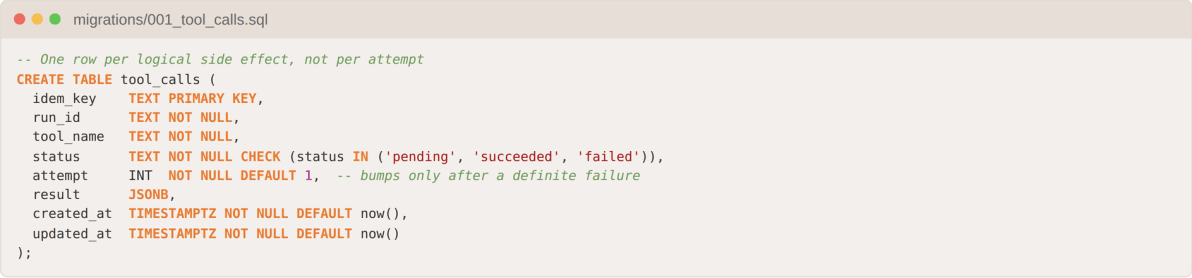
Code 1. The idempotency ledger in PostgreSQL.

Code 2: A claim-before-execute idempotency wrapper for agent tools.

Code 3: Declaring which arguments define “the same email.”
Why this works:
The claim is atomic: a PostgreSQL INSERT … ON CONFLICT upsert lets exactly one concurrent call per key win. Identity fields survive rewording, so a re-planned call with a new body maps to the same key.
Timeouts, dropped connections, server or gateway errors, and failed ledger writes after a successful call all leave the row pending, because the API may have succeeded. Retries get a non-retryable “check status first” reply until the five-minute stale window passes, and the re-claimed row then reuses the same downstream key.
When to use which
If the downstream API accepts an idempotency key, as the Stripe idempotency key header does, forward it. Without one, the ledger is not exactly-once: a pending step can run again after the stale window, so pair it with a read-only status tool. Stripe also stores failures, so after a definite failure the attempt counter issues a fresh key. Read-only tools need no ledger, and a legitimate repeat needs a sequence number from workflow logic, never from the model.
Why do AI agents get stuck in loops?
Loops undermine AI agent reliability through feedback: the model gets a result that looks like failure or carries no new information, and it tries again.
The usual trigger is an error like a bare “Request failed” that never says the date format was wrong. Tool schema drift causes the same confusion more quietly. A step budget bounds the worst case; repeat detection and structured errors catch tight loops early.
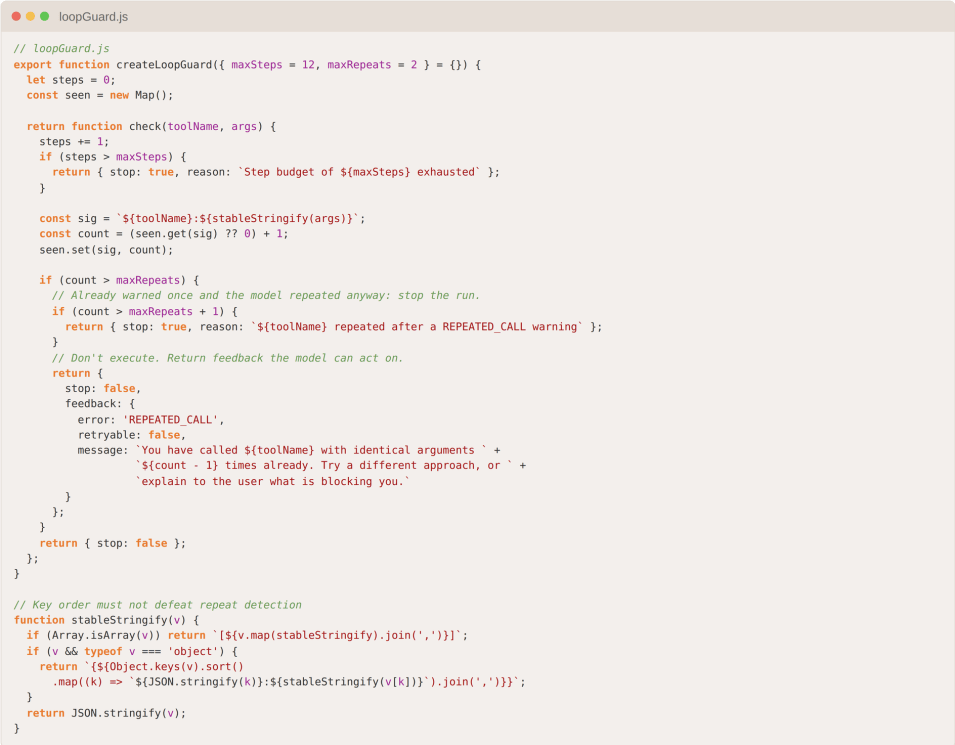
Code 4: A loop guard with a step budget and repeat detection.
Why this works
The step budget caps cost and latency whatever the model does, and repeat detection steps in at the second identical retry. Returning feedback as a tool result instead of throwing lets the model switch tools, ask the user, or explain the blocker. If the model ignores that warning, the guard stops the run. Bounded runs also make LLM cost optimization predictable.
How should you set AI agent timeouts for LLM and tool calls?
Use layered deadlines: a budget for the whole run, a timeout for each tool call, and a rule that a child never outlives its parent.
Stalls erode AI agent reliability quietly, because HTTP clients often wait minutes by default and sequential slow tools multiply the wait.

Figure 2: Layered deadlines: each layer runs inside the time its parent has left.
Node.js 20.3 and later make this composable with AbortSignal.timeout() and AbortSignal.any(), both built into the Node.js global API.

Code 5: Per-tool timeouts bound by the run’s deadline.
Why this works
AbortSignal.any()binds the tool’s limit to the run’s deadline, so a tool that starts late gets less time. Passing the signal intofetchor the SDK cancels the request and frees the socket. A read-only timeout is safe to retry. A write timeout means unknown, so the model must check status first while the ledger absorbs careless retries. Passctx.runSignalto every model call too, so a slow completion cannot outlive the run.
How to verify it worked
Inject a fault: point a tool at an endpoint that sleeps past the timeout and confirm a prompt TIMEOUT, a closed connection, and a run that moves on. A repeat write call should get IN_PROGRESS.
Where should retry logic live: runtime or model?
Good AI agent error handling retries at the lowest layer that can actually fix the problem.
The model cannot fix a 503 from a CRM API; handing it that error wastes a turn and invites a reworded duplicate. It can fix a malformed date. AI feature error handling for user-facing features follows the same classification.

Table 2: Routing tool errors to the layer that can fix them.
Validate each call’s arguments and result against the tool’s JSON schema so malformed calls return to the model as fixable errors. For the transient class, a small helper inside the tool is enough.

Code 6: Runtime-level retries for transient failures only.
Why this works
Exponential backoff gives a struggling API time to recover, and full jitter stops runs that failed together from retrying together, as AWS shows in its exponential backoff and jitter analysis. Keep attempts low, since each one spends the tool’s timeout, and honor the HTTP Retry-After header on 429 responses, giving up when it exceeds the tool’s budget. For write tools, keep AI agent retry logic inside the idempotent wrapper so every attempt carries the same key, and retry only when the downstream API honors that key.
If your agents touch CRMs, email, payments, or data pipelines, this layer decides whether they hold up. Talk to our AI workflow engineering team about hardening your agent’s failure handling before launch.
How do you recover when a multi-step agent fails halfway?
Decide per workflow, in advance, whether a failure resumes from a checkpoint or runs compensating actions.
Re-running under the same run ID replays completed steps from the ledger; a pending step needs a status check first, and some failures call for undoing work. Checkpointing persists state after each step, so a run survives a process crash and resumes; LangGraph checkpointers and platforms such as Temporal and Inngest are built around the same idea. The saga design pattern pairs each side effect with a compensating action, such as canceling a reservation, which needs its own idempotency key. Put human approval in front of anything irreversible, alongside the access controls covered in AI data governance.
What should you monitor for AI agent reliability?
Trace every tool call with its run ID, tool name, idempotency key, and outcome, then track a few metrics.
Spans let you reconstruct any run, as in RAG pipeline debugging. Watch duplicates suppressed per tool, loop-guard trips, timeout rate and p95 latency per tool, retries per run, and graceful-exit rate.
Conclusion: treat the model as an unreliable client
The model will sometimes retry wrongly or chase something that cannot work, and the runtime must absorb it.
Claim idempotency keys before side effects, bound every run with a step budget and layered deadlines, route each error class to the layer that can fix it, and checkpoint multi-step work. Together, these patterns build reliability into the runtime, where the model cannot undo it. For a second set of eyes on your agent’s failure paths, request a failure-handling review from ScriptsHub Technologies.
Frequently asked questions
Q. What is AI agent reliability?
It is an agent’s ability to complete multi-step tasks correctly and safely, without duplicate side effects, runaway loops, or stalls, even when the model, tools, or APIs around it fail.
Q. Why do AI agents experience low reliability?
Unlike single-turn models, agents run multi-step loops. If each step succeeds 95% of the time, a 10-step workflow drops total success to roughly 60%. Errors compound exponentially with every added step or tool integration.
Q. What causes “agent drift”?
Agent drift happens when a system’s performance degrades over time. This is typically triggered by data drift, updates to the underlying LLM, changes to external API contracts, or cluttered context windows that confuse the agent’s core instructions.
Q. How do you measure AI agent reliability?
Reliability is measured using production observability tools and continuous evaluation suites. Teams track end-to-end task success rates, tool call accuracy, latency, token efficiency, and how successfully the agent handles edge cases and adversarial inputs.
Q. How can you improve agent reliability in production?
Implement deterministic guardrails, strict input/output data validation, and distributed tracing. Additionally, using a “thin orchestrator” architecture and durable execution frameworks helps the agent recover safely from network or API timeouts.
About ScriptsHub Technologies: ScriptsHub Technologies is a data engineering and full-stack development firm serving clients in the US, UK, and India. Our team builds data platforms, Power BI solutions, and AI-powered workflows in Python and Node.js. Learn more at scriptshub.net or reach us at info@scriptshub.net.
© 2026 ScriptsHub Technologies LLC · scriptshub.net · info@scriptshub.net


