

Quick summary:
Applied-AI projects rarely fail at the model. They stall after the demo, in the AI data pipeline: loaders that double-load on retry, vendor column names nobody understands, backfills that corrupt live tables, and schedules that let a model answer from stale data. This guide covers the six pipeline stages, schema contracts, idempotent loaders, backfills, and freshness gates, with tested code.
If your AI pilot impressed everyone in week one and has been “almost ready for production” ever since, the problem is almost certainly not the model. Typical AI Data Pipeline symptoms include a retry that doubles last night’s rows, a CRM column rename that silently empties a retrieval index, and a chatbot quoting numbers from Tuesday. Our data engineering team at ScriptsHub Technologies sees these symptoms when AI initiatives move from exported CSVs to live sources.
Research agrees. Google’s paper on hidden technical debt in machine learning systems found that model code is a small fraction of a production system, and Gartner predicted in 2025 that organizations would abandon 60% of AI projects unsupported by AI-ready data through 2026. Plans still budget as if the model were the project.
What is an AI data pipeline?
An AI data pipeline is the automated system that extracts data from source systems, validates it against a schema contract, loads it idempotently, and delivers it fresh to train, ground, and operate the models, retrieval indexes, and agents that depend on it.
The general answer to “what is a data pipeline?” is any automated flow from sources to a destination, with the classic ETL pipeline feeding a warehouse as its familiar form. IBM’s AI pipeline guide describes the AI data pipeline as continuously delivering data for AI, feeding the machine learning pipeline that MLOps teams run for training and deployment. The difference is the consumer: a language model turns whatever arrives into fluent prose, so every defect reaches users in a confident voice.
What are the six key stages of an AI data pipeline?
The six key stages of an AI pipeline are ingestion, preparation and cleaning, feature engineering or indexing, storage, training and inference, and monitoring with feedback, and each fails predictably when the plumbing underneath is weak.
Compared with a reporting ETL pipeline, the AI version also ingests unstructured inputs such as documents and transcripts, keeps data lineage to trace a bad answer to its source rows, and feeds monitoring signals back into retraining. Table 1 maps each stage to its common failure.

Table 1. AI data pipeline stages, where each one breaks, and which section of this guide covers the fix.
Why do AI projects stall between the demo and production?
AI projects stall because the demo ran on an export someone made by hand, and production must replace that person with machinery that runs unsupervised every night.
Most demos start with a CSV, a notebook, a model call, and a screenshot. The export was clean because someone prepared it that morning. Production swaps that person for connectors, loaders, contracts, orchestration, and freshness checks (Figure 1).

Figure 1. The week-one demo stack and the stack that ships. Every orange layer exists only to replace a manual step from the demo.
An illustrative effort map for an applied-AI delivery puts prompt and model work at one slice among seven, with data workstreams taking roughly three-quarters of engineering time (Figure 2). In Google Research’s study of data cascades in high-stakes AI, one of 53 practitioners put it bluntly: “Everyone wants to do the model work, not the data work.”

Figure 2. Illustrative effort distribution for an applied-AI delivery. Values are representative, not a measured benchmark.
How do schema contracts keep an AI data pipeline stable?
A schema contract, also called a data contract, keeps a pipeline stable by recording each source column’s canonical name, type, and nullability in version control, so an upstream change fails loudly at load time instead of quietly downstream.
Source systems speak vendor vocabulary. A CRM activity table calls the related lead regardingobjectid and the completion time actualend, while prompts, retrieval indexes, and analysts need lead_id and completed_at. The rename map between them (Figure 3) is routinely underestimated.

Figure 3. A rename map from vendor columns to a canonical schema, versioned beside the loader that enforces it.
We treat the map as a contract: exhaustive, so a new upstream column shows up as a visible diff; versioned beside the loader and reviewed like code; and typed, which turns documentation into executable validation.
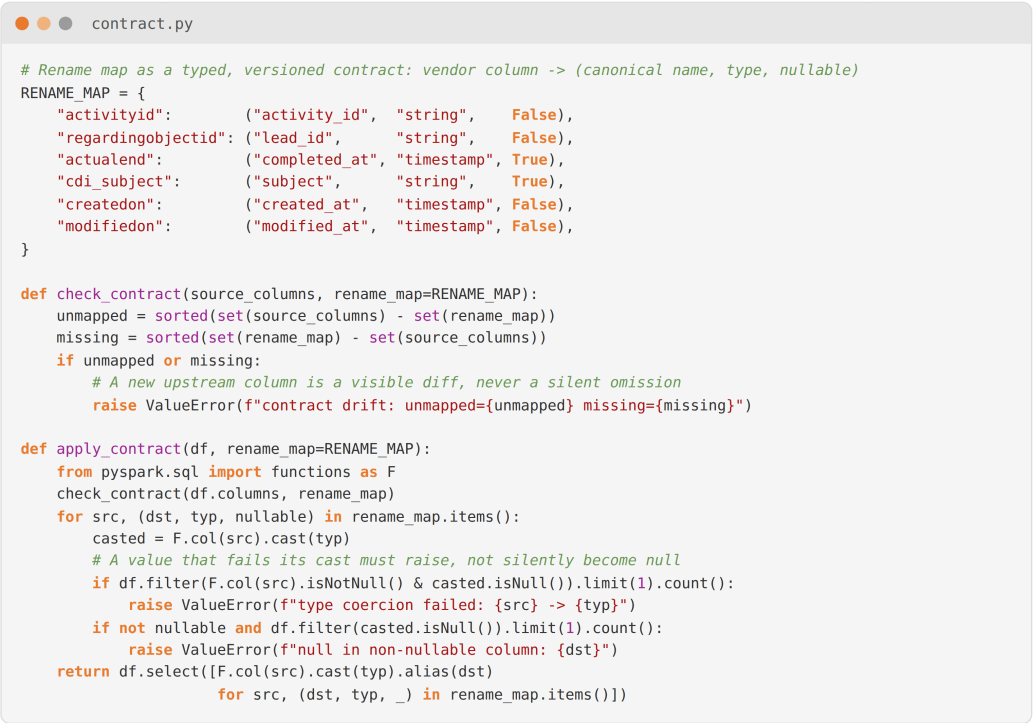
Why this works:check_contract fails on drift in both directions, catching unmapped new columns and mapped columns the source dropped. apply_contract raises when a value fails its type cast rather than nulling it, rejects nulls in non-nullable columns, then renames in one select so no vendor name leaks past staging.
How do you build an idempotent data loader?
Build an idempotent data loader by upserting on a natural key and advancing the watermark only after the target commit succeeds, so any failed run can be re-run.
An idempotent loader gives the same result whether it runs once or five times. Without that property, a loader duplicates rows after a retry and skips rows after a crash between extract and commit. Append-and-hope turns each failure into a cleanup project, and the pattern in Figure 4 makes each a non-event; Table 2 compares alternatives.

Figure 4. The idempotent incremental loader. Any failed step re-runs from the last committed watermark.
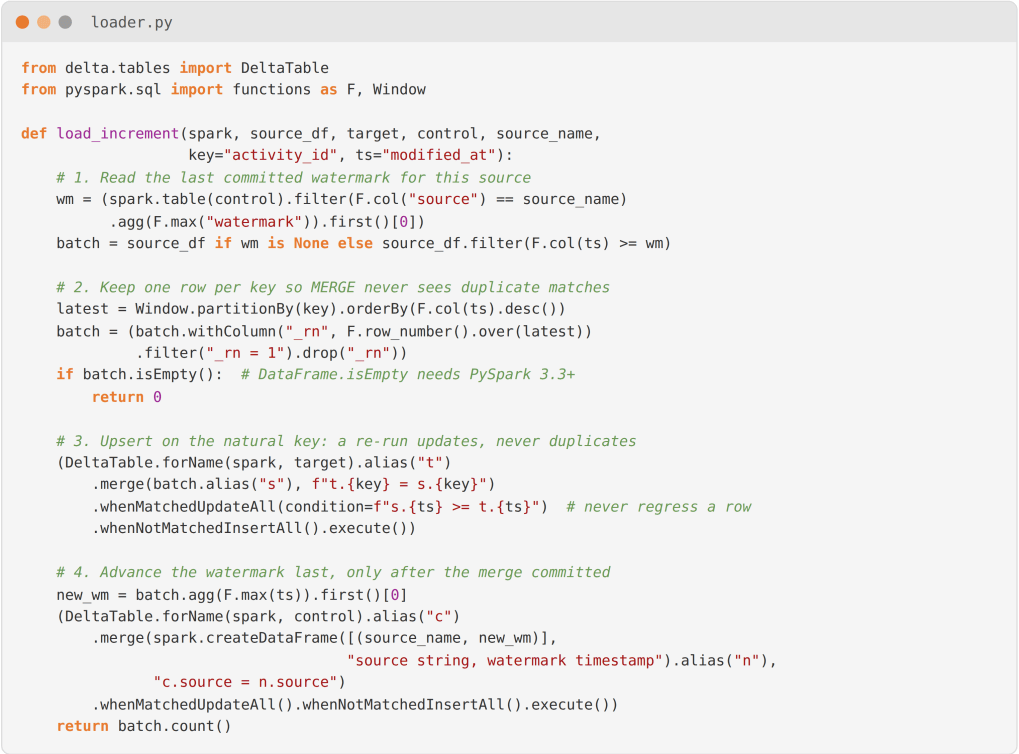
Why this works: The watermark moves last. A crash after the merge means the next run re-reads a loaded window, which the upsert makes harmless; the reverse order would silently skip a window. The match condition stops an older replayed row from overwriting a newer one. Keeping one row per key avoids the ambiguous-match error that Delta Lake MERGE INTO raises when two source rows hit the same target row, and the >= comparison re-reads rows that share the boundary timestamp.
How to verify it worked: Run the loader twice and confirm the row count holds, then, in a test environment, delete the control row and re-run. We tested this on local Delta Lake (PySpark 3.5.3, delta-spark 3.2.1). For late-arriving records, see incremental loads with watermarks; for Synapse specifics, see incremental data loading in Azure Synapse. Microsoft Learn documents Delta Lake upsert with MERGE.
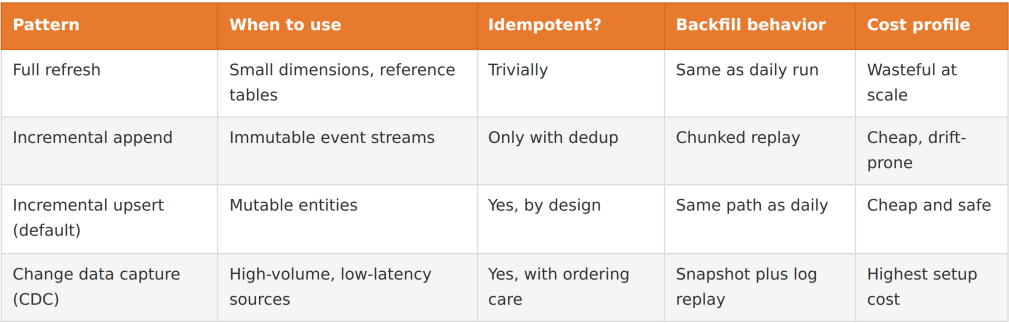
Table 2. Loader patterns. Incremental upsert is the default; deviate only with a reason you can write down.
If your AI pilot is stuck behind unreliable loaders, ScriptsHub Technologies’ data engineering and analytics services build these contracts and gates for production AI workloads.
How should you run a backfill without corrupting a live table?
Run a backfill in resumable chunks through the same upsert path as the daily load, then reconcile row counts and checksums for every chunk against the source.
Every incremental data pipeline eventually loads the past. Backfills look like big incremental loads but behave differently, with far more volume, API rate limits unseen at daily scale, and a live table that must stay queryable (Figure 5).

Figure 5. Illustrative load volume through a go-live: a multi-million-row backfill burst, then a daily steady state roughly two orders of magnitude smaller.
Chunk by a stable key or time window so a failure costs only one chunk. Route the backfill through the production upsert path, because a fast path that skips validation writes corrupted history at scale. Record counts and checksums per chunk so “the backfill completed” is a verified claim. On shared capacity, run heavy chunks off-hours to avoid Microsoft Fabric capacity throttling.
How do freshness gates stop AI from answering with stale data?
A freshness gate records the maximum acceptable age for every table the AI layer consumes and blocks downstream runs when any input exceeds it.
Freshness matters more for AI than for dashboards, because a dashboard shows its date and a model does not. A retrieval-augmented system fed stale documents answers fluently and wrongly, with no signal in the interface (Figure 6).

Figure 6. A freshness gate blocks the downstream run because the email extract is older than its 26-hour limit.

Why this works: The gate fails closed, so a late or missing extract stops the feature build instead of feeding it. Any data pipeline tool that runs a Python step before the downstream job can host it. When it passes, it returns the oldest load time to stamp onto retrieval results. Our RAG pipeline debugging guide shows how retrieval fails silently.
How does data pipeline quality become model quality?
Pipeline errors compound across stages, so small per-stage defect rates turn into large, model-visible damage by the time data reaches the model.
Errors that enter before the machine learning pipeline rarely announce themselves: a duplicated join row becomes a double-counted metric the model reports as fact, and a dropped rename becomes a null the retrieval index silently omits. At a 5% error rate per stage, eight stages leave only 66% of records fully correct. At 0.5% per stage, 96% survive (Figure 7).

Figure 7. Compounding of per-stage error rates across pipeline depth, computed as (1 − error rate) raised to the number of stages.
The compounding arithmetic is the case for spending the AI budget on plumbing, because a model makes whatever it receives sound fluent. Where two systems must agree, LLM data reconciliation catches mismatches that row counts miss.
What should teams budget and ship first?
Budget a clear majority of engineering effort for data work, and ship the schema contract, loaders, and freshness definitions before the model.
The operationalizing machine learning interview study of 18 ML engineers named validation as one of three variables that govern production success. Treat any loader that cannot be safely re-run as a defect, and when stale data cannot block a run, let its age travel into the model’s context.
This guide assumes batch-dominant architectures. A team reading from one governed lakehouse inherits much of this plumbing; a team consuming five vendor systems inherits none. Popular data pipeline tools such as Azure Data Factory, Databricks, and Fabric implement these disciplines differently without removing any. Language models now help with the plumbing itself: Stanford research on foundation models for data cleaning reported state-of-the-art results on cleaning and integration tasks without task-specific training.
Conclusion
The model is the visible, smaller part of an applied-AI project. Teams that ship treat the data pipeline as the product: contracts reviewed like code, re-runnable loaders, reconciled backfills, and freshness enforced before a model answers. Before your next AI launch, book a data pipeline review with ScriptsHub Technologies and our engineers will find where your pipeline loses data.
Frequently asked questions
Q. What are AI data pipelines?
An AI data pipeline is an automated system that ingests, cleans, and delivers data to train, ground, and operate AI models. It also enforces schema contracts, idempotent loads, and freshness, because models cannot flag bad inputs.
Q. What are the six key stages of the AI pipeline?
The six stages are ingestion, preparation and cleaning, feature engineering or indexing, storage, training and inference, and monitoring with feedback. Monitoring sends drift and accuracy signals back into retraining.
Q. Will ETL be replaced by AI?
No. AI is starting to assist ETL work, such as drafting rename maps and flagging mismatches, but loaders, contracts, and reconciliation still need deterministic ETL pipeline logic that can be tested and safely re-run.
Q. What is a data pipeline example?
A nightly CRM loader is a common data pipeline example. It extracts changed activity records, renames vendor columns, upserts them into a lakehouse table, and advances a watermark; the retrieval index then rebuilds from that fresh table.
Q. How do I build an AI pipeline?
Build an AI data pipeline in order: a schema contract first, then idempotent loaders that upsert on a natural key, backfills through the same path, freshness gates before model runs, and per-stage error monitoring.
About ScriptsHub Technologies. ScriptsHub Technologies is a data engineering and applied AI consultancy serving clients across the US, UK, and India. Our teams build production data pipelines on Azure Synapse, Databricks, and Microsoft Fabric, alongside Power BI reporting and AI systems grounded in reliable data.


