

Quick Summary:
LLM data reconciliation detects silent data drift, the semantic disagreement between two systems of record that both look healthy. ScriptsHub Technologies built a three-layer architecture for a high-volume operations team whose CRM and operational database quietly disagreed on record status. Deterministic SQL pairing cut north of a million paired records to a few thousand suspects. A semantic data matching layer separated vocabulary differences from real contradictions. Humans owned every write-back.
LLM data reconciliation detects silent data drift: syntactically valid, semantically contradictory state between two systems that are supposed to agree. Those were the symptoms when an operations team asked our data engineering and analytics team why their work queues kept surfacing records that had already closed.
What Is Silent Data Drift Between CRM and Downstream Systems?
Silent data drift is syntactically valid, semantically contradictory state between two systems that are supposed to agree. It is caused not by broken code but by working code operating on mismatched assumptions, and four mechanisms account for most of what we find.
The mechanisms compound rather than sitting side by side. A nightly integration against hourly status changes leaves a sync-lag window in which both systems are legitimately out of step, and inside that window a vocabulary gap – one system exposing noticeably more status values than the other, mapped by someone who has since left – turns ordinary CRM data synchronization lag into apparent contradiction. Partial updates that copy a status without its date make the two indistinguishable, and manual edits made downstream leave nothing for either system to reconcile against.
None throws an exception. Each system stays internally consistent on its own terms, and the contradiction exists only in the relationship between them, where no software is looking.
Why Do Traditional Data Quality Tools Miss Semantic Drift?
Traditional data quality tools miss semantic drift because their rules are column-scoped inside a single dataset, and a cross-system contradiction is neither. Microsoft Purview’s data quality rules cover six standard dimensions – completeness, consistency, conformity, accuracy, freshness, uniqueness – all at column level. Academic evaluation agrees: automated detection performs well on structural violations and poorly on semantic data errors that need external context.
“Active” in one system and “Closed – Terminated” in the other are both valid strings that no schema constraint can object to. The knowledge needed to say they conflict lives in status vocabularies and lifecycle semantics, not in any column definition.
Most writing on this topic addresses a different problem: unstructured intake, where models parse PDF remittance advices and payment memos. Here both records already parse cleanly, so the disagreement is about meaning rather than format, which is why extraction-focused tooling never touches it.
That contextual judgment is where an LLM for data quality earns its place. Models approximate it on semantic data matching and error detection benchmarks, and later work on entity matching with large language models shows they can explain a match as well as make one. The question is how to build a system around that judgment that stays affordable and auditable.

A working taxonomy of cross-system disagreement. The resolution path differs by class, which is why classification has to precede any fix.
How Does LLM Data Reconciliation Work in Production?
Our AI data reconciliation architecture separates the problem into three layers, each answering a question the layer below it cannot. Deterministic code finds candidates, the model applies judgment, humans own the resolution, and confirmed rules feed backward into the deterministic layer, which is what makes the system cheaper over time.

The volume callouts on the right are the point: the model never sees the full population, only what Layer 1 could not settle.

How Do You Verify Cross-System Data Consistency in SQL?
Cross-system data consistency starts as a join. The first layer pairs both systems on the shared key and computes the disagreement set: records whose mapped statuses do not match, whose status is missing from the active map, or whose timestamps diverge beyond the sync window. It is exact and cut our client’s candidate set by more than two orders of magnitude before a single token was spent.
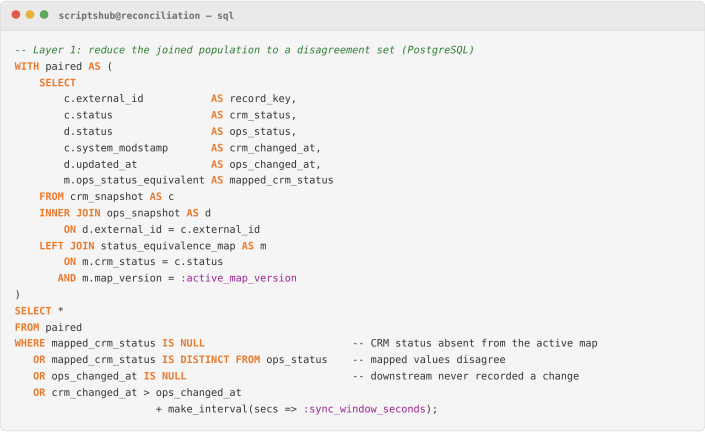
Why this works:
IS DISTINCT FROMtreats null as a comparable value, so a disagreement surfaces even when one side is null, and the separatemapped_crm_status IS NULLclause catches statuses missing from the map where the downstream value is also null.(crm_status, map_version)must be unique in that map, or the left join multiplies rows – a governed artifact needs the constraint that makes it governable. The staleness check is directional on purpose: an absolute difference would flag every long-settled record whose systems were written minutes apart. In Salesforce,SystemModstampis the CRM data synchronization timestamp that also advances on automated updates and is indexed, so deltas built onLastModifiedDateunder-report change – the same discipline behind our schema drift detection in Azure Data Factory work.

The reconciliation funnel on a representative production population: each tier is roughly an order of magnitude smaller than the one above it.
Curious what your own funnel looks like? We run the Layer 1 query as a fixed-scope reconciliation assessment – no model, no integration work, just the disagreement set from your two systems.
One precondition governs this layer: a stable, shared join key. Where it is missing, entity resolution is a separate problem to solve first. You cannot ask which record is correct until you are confident both describe the same thing.
How Does the LLM Handle Semantic Data Matching?
Semantic data matching begins where the deterministic filter ends. The model sees only the suspects, each arriving with values, timestamps, an activity summary, and the current equivalence map. From that it answers what rules cannot: whether the disagreement is real or merely vocabulary, which system is probably authoritative given the lifecycle stage, and whether a hundred mismatches share a pattern.
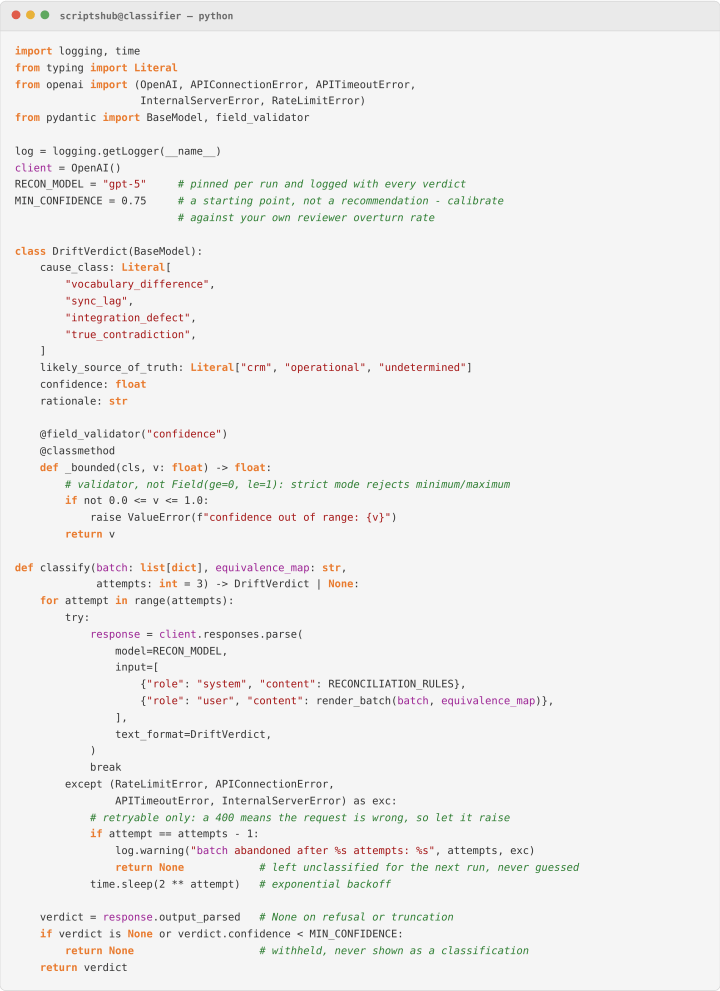
Naming the authoritative system is work that has to happen before the model runs. If nobody has decided which system owns which lifecycle stage, the model asserts an answer anyway and reviewers have no basis to check it.
Why this works: JSON schema structured outputs constrain generation to the schema you supply, so downstream tooling consumes a typed verdict rather than parsing prose – also available through Azure OpenAI structured outputs. The strict subset has no numeric bounds, so the confidence floor is enforced in code and the range check sits in a validator rather than in
Field(ge=…, le=…), which would emitminimumandmaximumkeywords that strict mode rejects. Treat 0.75 as a starting point and calibrate it against your own reviewer overturn rate. A nightly batch also has to survive a 429 or a 500, so the call is wrapped in bounded retries with exponential backoff, and an abandoned batch stays unclassified rather than guessed – the same discipline we set out in [[LINK-A – verified slug required: LLM API failure handling post]]. Batching by status pair matters as much: one classification amortizes across every record showing the same mismatch, keeping token spend proportional to distinct mismatches rather than to record count.
We apply the same constraint across our AI development services, because free-text output needs a parsing layer that eventually breaks on a response nobody anticipated.
Why Must Humans Own the Resolution Step?
Humans must own resolution. Writing a model-decided value into a system of record converts a drift problem into a corruption problem. It is harder to detect than the drift you started with. The output is a reviewed worklist, not a write-back.
Reviewers confirm or overturn each verdict. Confirmed equivalences graduate into the governed map, confirmed defects become tickets against the sync job, and true contradictions are corrected in the losing system. Every verdict is stored with its full input, model identifier, and schema version – a reproducibility practice the NIST AI Risk Management Framework treats as central to trustworthy deployment, and one we build in alongside our AI data governance work.
A natural-language interface over the worklist is a reasonable extension, provided it reads logged verdicts rather than re-classifying on demand.
Data minimization belongs here too: the classifier needs status values and dates, not names or contact details.
If your systems disagree and nobody owns the answer, our data analytics services team can help you settle authority before any model runs.
Reproducibility is the obvious objection. It is a large enough topic to stand on its own. Language models are probabilistic, so the same suspect pair can draw a different verdict on a rerun. Verdict caching, a confidence floor, and sampled re-review make the system reproducible even though the model does not. We cover the controls in detail in building an LLM audit trail for reproducible verdicts.
What Does LLM Data Reconciliation Cost at Scale?
Reconciliation costs scale with the exception rate rather than the population, which for a mature integration runs from a fraction of a percent to a few percent of the joined set. The naive approach to AI data reconciliation hands both tables to a model instead, and fails twice over: token volume scales with the full population, and long-context recall across tens of thousands of rows is exactly where models drop cases silently.
Layering fixes both, and two effects compound: batching by status pair amortizes classification across hundreds of records, and every rule a reviewer confirms moves permanently from Layer 2 into Layer 1. The model’s queue shrinks as the deployment matures rather than growing alongside it.
Set against the alternatives:

How Do You Operationalize Cross-System Data Reconciliation?
Run cross-system reconciliation on the sync schedule plus one buffer cycle so ordinary lag never registers as drift – the cadence behind our real-time Azure data pipeline work. Then track two curves: the confirmed-drift backlog and the weekly rate of new drift. Neither improves until integration fixes ship.
[[FILL-1 – BLOCKS PUBLICATION]] One paragraph of real friction from the engagement goes here: what the team got wrong first and what it cost to correct. See TEXTURE-BRIEF.md. This must be written by someone who ran the engagement – it cannot be drafted from the source whitepaper without inventing it.
The first measurement surprised everyone. Field-level mismatch ran at a fraction of one percent. Negligible as a ratio, and still several hundred records driving the wrong downstream action. Over the following quarter the backlog fell once the governed equivalence map shipped, and new drift fell only after classified patterns became integration fixes.
The most durable artifact was not the alerts. It was the equivalence map. A reviewed, versioned record of what each status in one system means in the other. With provenance for who confirmed it. The organization was reverse-engineering the undocumented contract between its own systems. Switch the LLM off. The map still serves as a data contract and as the rule set for a deterministic monitor.
Conclusion
LLM data reconciliation works because it puts the model where judgment is required. It keeps it away from everything a join does for free. Cross-system data consistency stays the deterministic layer’s job, and humans keep write authority. The limits: the SQL layer only surfaces disagreement classes someone thought to encode. Equivalence maps need re-validation whenever either system changes its vocabulary.
Two systems disagreeing quietly is not a monitoring problem – it is an architecture problem. If your CRM and your operational systems have never been formally reconciled, talk to ScriptsHub Technologies about an AI data reconciliation assessment. We will tell you your real disagreement rate before proposing anything to build. Our AI consulting team can scope it against your stack.
Frequently Asked Questions
Q. What is LLM data reconciliation?
LLM data reconciliation uses a language model to classify why two systems of record disagree. Deterministic SQL narrows millions of records to a small suspect set. That set needs semantic judgment.
Q. Can an LLM replace SQL for semantic data matching?
No. SQL pairing is exact and effectively free, while inference costs money and degrades over long contexts. Use an LLM for data quality judgment only; let SQL find the candidates.
Q. Is the model’s judgment accurate enough for audit?
Only with controls. Cache verdicts against hashed inputs so reruns reproduce, set a confidence floor, and keep every exact comparison in SQL. The model explains discrepancies; it never computes the answer.
Q. Does AI data reconciliation work on PDFs, invoices, or bank statements?
No. This architecture reconciles structured records that already parse cleanly. Document-heavy reconciliation is a different problem, where the model earns its place at extraction.
Q. How do you stop the model from writing bad data back into your CRM?
Never write back automatically. The system produces a reviewed worklist. Humans confirm each verdict, and only the team owning the losing system applies the correction.


