

Quick summary:
Agentic testing hands exploration, authoring, and maintenance of a test suite to AI agents that work from goals instead of scripts. This composite case study from ScriptsHub Technologies’ quality engineering work applies it to a brittle Playwright suite. Two gates made it safe: a triage step that decides which failures an agent may repair, and an assertion guard that stops a healer from rewriting expected values. We close with a tool comparison and a rollout plan.
Your end-to-end suite turns red after every UI release, engineers repair selectors more than they add coverage, and nobody trusts a failed build until it is rerun. If that sounds familiar, your automation almost certainly encodes how to click instead of what should be true. Our quality engineering team sees these symptoms across client suites; the composite case below follows a B2B SaaS portal as its regression work moves to agentic testing and AI test automation.
What is agentic testing?
Agentic testing is software testing in which an AI agent receives a goal, plans its own steps, runs them against the live application, judges the outcome, and adapts when the interface changes.
The agent follows a reason, act, and observe cycle, the pattern formalized in the ReAct research on reasoning and acting AI agents. You give it an intent such as “a returning customer can check out with a saved card,” not a click path. It inspects the DOM and ARIA roles the way a tester would, picks the next action, and checks the result, so a renamed button no longer stops the run.
Most AI testing tools today are assistive: they help an engineer write or patch a script, but nothing reasons at runtime. Autonomous testing describes how much of the lifecycle runs without a person; “agentic” describes the mechanism. Agentic systems sit at the autonomous end of AI software testing yet still let humans approve changes, which we recommend.
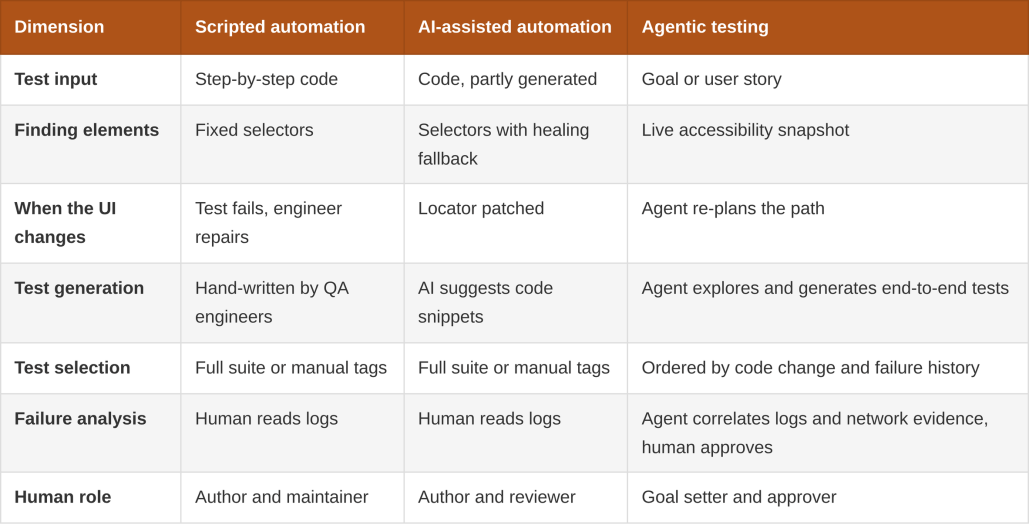
Table 1: How agentic testing differs from scripted and AI-assisted test automation.
Why do scripted test suites keep breaking?
Scripted suites break because they hard-code the path to an outcome, so a renamed element or a slower response fails the test even when the feature still works.
The portal’s Playwright suite of 640 tests ran on every merge while weekly releases kept renaming components. Engineers spent 18 hours a week on selector repair, and real defects slipped through because developers had learned to rerun red builds.
Google’s testing team reported in 2016 that almost 16% of its automated tests showed some flakiness and that about 84% of observed pass-to-fail transitions involved a flaky test. Once rerunning becomes a reflex, automated software testing stops working as a signal.
A month of failures traced mostly to locator drift, timing, and staging outages; genuine regressions were rare. That shaped the design: an agent allowed to repair every failure would also quietly repair the real bugs.
How do AI agents explore an application?
An exploring agent opens the application in a real browser, reads its accessibility tree, and walks user flows to produce a human-readable test plan before any test code exists.
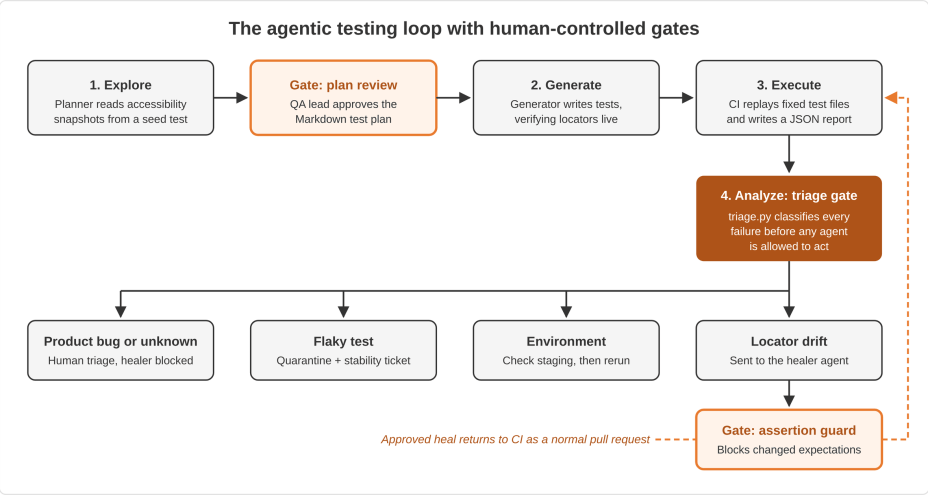
Figure 1: The agentic testing loop we deployed, with the two human-controlled gates added by ScriptsHub Technologies.
Because the portal already used Playwright as its test automation framework, we adopted the Playwright test agents added in version 1.56: planner, generator, and healer. Each runs inside a coding agent, driving the browser with tools modeled on the Playwright MCP server for AI agents, which exposes pages as accessibility snapshots instead of screenshots. Reading roles rather than pixels keeps exploration cheap and repeatable.
Exploration starts from a seed test that signs every agent in. Here is the scaffold and seed:


Why this works
The init-agents command writes the agent definitions and MCP configuration into the repository, so every instruction is version-controlled. The seed gives a deterministic start, and credentials come only from environment variables.
QA leads reviewed the planner’s Markdown plan before generation, adding rules such as which totals must reconcile with invoices.
How do AI agents generate and execute tests?
The generator agent turns an approved plan into Playwright test files, checking each locator and assertion against the live page as it writes, and CI then executes those files like any hand-written test.
Generated tests are ordinary code that goes through pull requests and CI. Execution stays deterministic: agents reason while authoring and repairing, but CI replays fixed files, keeping failures reproducible. Agentic pipelines also prioritize. Playwright’s --only-changed flag runs test files changed since a git reference and --last-failed reruns prior failures, so both run ahead of the full sharded suite; some platforms add risk scores from failure history. For agents that verify their own changes before a pull request, see our walkthrough on wiring AI test automation into the coding loop.
When to use which
Use agent-generated tests for broad UI regression and thinly covered flows. Keep hand-written tests for business rules such as pricing and permissions, where a person should own every assertion.
How do AI agents analyze test failures?
Failure analysis determines whether self-healing test automation improves reliability or introduces new risks. An AI healer can fix broken locators or rewrite assertions that detect real bugs.
As of Playwright 1.63, the generated healer’s default instructions include fixing assertions and expected values. If a billing page shows $108.00 and the test expects $120.00, a healer that edits the expectation turns a defect into a green build, one of the bugs AI debuggers miss.
Our fix was a triage step, the first layer of root cause analysis, that routes each failure from Playwright’s JSON report before any agent touches a test. For drift cases the healer gathers deeper evidence from console messages, network requests, and page snapshots, separating a missing element from a failed API call.

Why this works
With retries enabled, the JSON reporter marks retry passes as flaky. A “Received:” line means the locator resolved but the value was wrong, the signature of a defect. Only locator drift reaches the healer.
How to verify it worked
A real report with a wrong total, a renamed link, an intermittent widget, and a refused connection routed all four correctly. Replay historical reports before trusting it in CI.
Weighing agents for an existing Playwright or Selenium suite? Our quality engineering team can review your test automation framework and show where agents will help.
What guardrails does autonomous testing need?
Autonomous testing requires clear limits on what AI agents can change and which data they can access. It must also restrict instructions agents accept from application pages.
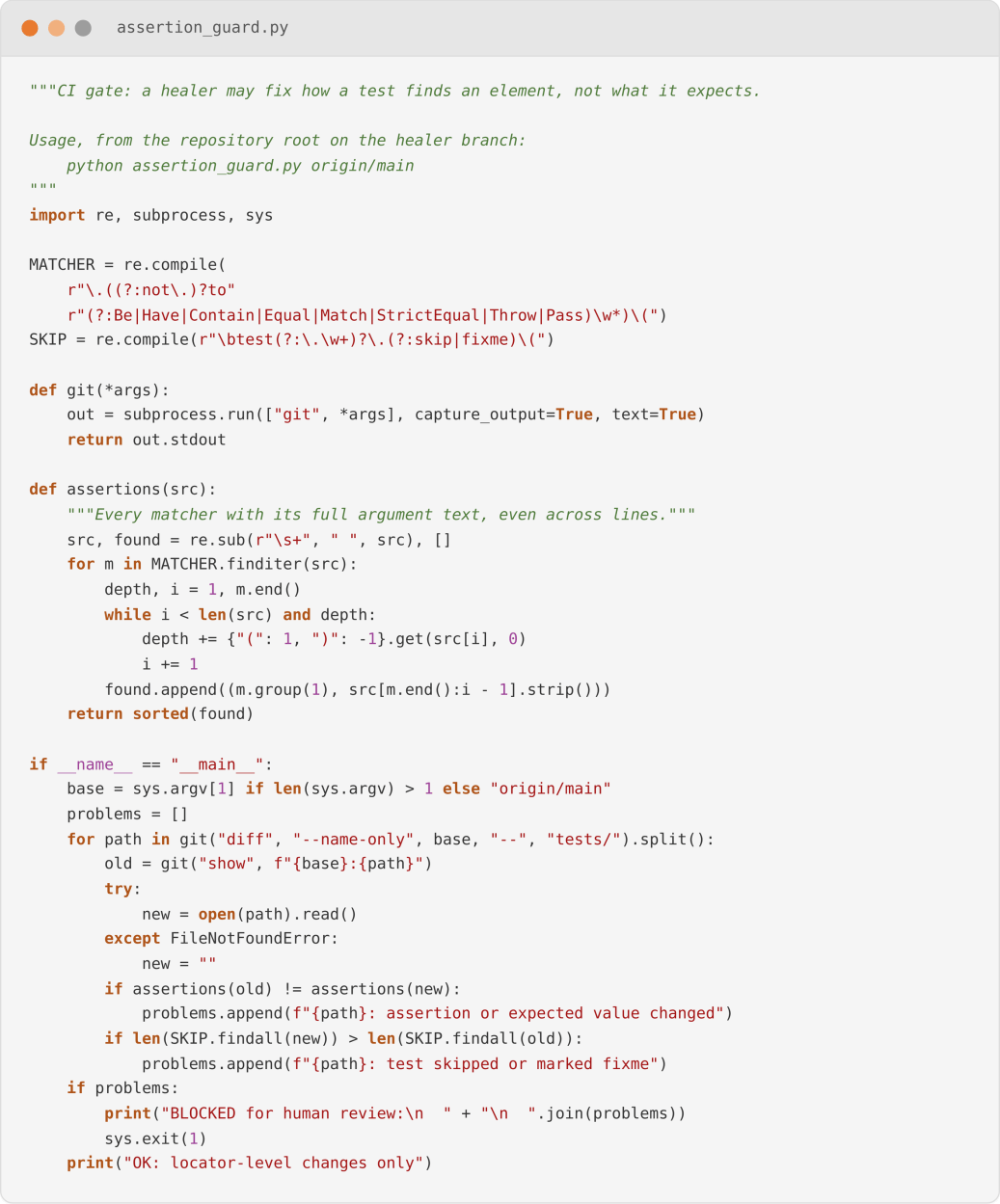
The second gate runs on every healer branch, allowing changes to how a test finds an element and blocking changes to what it expects.
Why this works
The guard compares every matcher, negation, and argument across each changed test file, including multi-line calls. A swapped locator passes; a rewritten value, deleted assertion, or new test.fixme() fails the job.
Page text can try to redirect an exploring agent, the risk OWASP ranks first as prompt injection in LLM applications. We ran agents only on staging with synthetic accounts and logged every tool call. Our guide to data governance for AI agents explains access controls. The NIST AI Risk Management Framework helps document these safeguards.
Gartner expects over 40% of agentic AI projects to be canceled by the end of 2027 because of cost, unclear value, or weak risk controls, which is why we scoped agents to measurable drift.
What results did the rollout deliver?
Over 12 weeks, weekly selector maintenance fell from 18 to 7 hours, and the share of red builds caused by real defects rose from 22% to 58%.
Composite case study drawn from ScriptsHub quality engineering engagements. Figures are illustrative, not measured; yours will vary.
Agents added 85 scenarios in previously unautomated flows. The healer resolved 72% of drift failures unaided, and the guard blocked 14 diffs that would have changed an expected value.
Costs rose with exploration depth, so we capped steps and used LLM routing to cut inference cost on routine healing.
Which AI testing tools offer agentic capabilities?
Most testing platforms now offer agentic testing features. They differ in how they approve self-healing fixes and keep tests portable as code.
Gartner forecasts that 80% of enterprises will integrate AI-augmented testing tools by 2027.

Table 2: AI testing tools with agentic capabilities, based on vendor documentation as of October 2026.
When evaluating agentic testing tools, consider emerging options such as ContextQA. Ensure every fix arrives as a reviewable diff, tests remain exportable to your test automation framework, and safety gates stay enforceable.
How should you roll out agents on an existing suite?
Start agentic testing with one frequently changing user flow. Keep humans responsible for approving plans and code changes. Expand gradually after triage and guardrails pass historical failure tests.
Pick a flow whose tests break for cosmetic reasons, add a seed, and have the business-rules owner review the plan. Merge generated tests through normal review, then wire triage after your test job and the guard on healer branches.
Track drift fixes, blocked diffs, and run cost for a month first.
Once agents run on scheduled workflows, explore our guides to AI agent reliability under tool schema drift and runtime reliability for AI agents in production.
Is agentic testing ready for production QA teams?
Yes, for UI regression and exploratory coverage, provided the agent’s authority stops at locators and plans.
The 2025–26 World Quality Report by Capgemini, Sogeti, and OpenText found that 89% of organizations are piloting or deploying generative AI in quality engineering. However, only 15% have achieved enterprise-scale adoption. For AI test automation, closing this gap requires trust. Human-controlled guardrails help ensure AI agents preserve expected results and maintain reliable software testing.
ScriptsHub Technologies helps teams add AI agents to existing suites without giving up control of their release signal. Book a QA automation working session and bring your flakiest flow.
Frequently asked questions
Q. Is agentic testing the same as autonomous testing?
No. Agentic describes the mechanism: an AI agent reasons toward a goal while the test runs. Autonomous describes how much of the testing lifecycle runs without people. Most production setups are agentic but only partly autonomous.
Q. How does agentic testing differ from traditional test automation?
Traditional automation runs predefined, rigid scripts that break during UI changes. Agentic testing uses goal-driven AI that dynamically creates paths, explores new edge cases, and adapts to application changes.
Q. What is self-healing in agentic testing?
Self-healing is the agent’s ability to repair broken tests automatically. If a UI element, selector, or layout changes, the AI detects the drift and updates the locator, while assertions stay under human review.
Q. What is the difference between generative AI and agentic testing?
Generative AI produces passive outputs, such as test code. Agentic testing goes further: autonomous agents use tools to run tests against the live application and act on what they observe.
Q. Will agentic testing replace QA engineers?
No, it enhances them. AI agents handle repetitive test maintenance, freeing QA engineers to focus on test strategy. They can also investigate complex edge cases that require human judgment.
About ScriptsHub Technologies
ScriptsHub Technologies is a data engineering and applied AI consultancy with teams in the US, UK, and India. Our engineers build data platforms, Power BI solutions, and analytics platforms. We also develop AI features and quality engineering practices that ensure production reliability. Learn more at scriptshub.net.


