

Quick Summary –
MCP-native QA exposes browser automation, test generation, and contract validation to coding agents as callable Model Context Protocol tools, so the agent verifies real behavior before opening a pull request. This guide covers why agent-written tests miss regressions and the three patterns that close the loop.
If your MCP-native QA agent-assisted pull requests keep passing review and generating support tickets, the gap sits between generation and verification. Those were the symptoms a B2B SaaS team brought to ScriptsHub Technologies: thirty green unit tests, two approvals, and an archive dialog promising thousands of records while one page changed.
What Is MCP-Native QA?
MCP native QA wires verification tools such as browser automation, test runners, contract checks, accessibility audits, and static analysis into a coding agent as callable tools, so verification happens inside the agent’s reasoning loop instead of after it.
The agent drives the running application, reads what came back, and repairs its own work before a human sees a diff.
Underneath the branding, the Model Context Protocol carries JSON-RPC 2.0 over stdio or Streamable HTTP. A server advertises tools through tools/list and runs them through tools/call, declaring a JSON Schema for each tool’s inputs. What matters for QA is timing: a tool call resolves inside the agent’s turn, so its result lands in the same context window as the reasoning that requested it.
Why Do AI Coding Agents Ship Regressions That Tests Miss?
Because the same agent writes the implementation and the tests in one turn, both inherit the same wrong premise, and CI feedback arrives after the session that could have acted on it is gone.
A team using a React front end and Node API migrated an admin records table from client-side filtering to a server-paginated endpoint. Before the migration, the select-all checkbox operated on the full dataset, so the row array and the total were one value. After the migration, the array became a page slice while the total arrived separately as meta.totalCount. As a result, the handler kept using the array, the label kept using the total, and the tests asserted against a fixture built from that same premise.
Safer Builders, Risky Maintainers, an MSR 2026 study of 7,191 agentic and 1,402 human pull requests, found agents introduced breaking changes less often than humans on generation work, 3.45% against 7.40%, but more often on maintenance: 6.72% on refactoring and 9.35% on chore work. It also names a confidence trap: pull requests self-rated 10 out of 10 still carried breaking changes.
The agent tests its own premises. When one agent writes implementation and tests in the same turn, both descend from a single mental model, so a wrong model produces a test that records the error. A systematic review of 115 studies on LLM unit test generation names weak fault detection as an open problem, and an evaluation of LLM unit test generation found models produced no valid test for 87.13% of known defects.
The repository does not hold the evidence. A running application produces signals that exist nowhere in source: the accessibility tree, the network waterfall, console warnings, and the database state after the handler ran. That gap is narrow for a pure function and wide for anything crossing a rendering boundary. It is the blind spot that lets cache invalidation bugs survive an AI debugger’s review, and the reason AI agents in production need runtime evidence.
Where the feedback lands: CI-gated verification vs MCP-native QA

Both paths run the same checks. The MCP-native loop returns them while the agent is still working.
How Does MCP-Native QA Close the Verification Loop?
Three patterns close it: browser observation as a callable tool, behavior-first test generation with contract validation, and review moved into the loop. Adopt them in that order.
Pattern 1: Browser Observation With Playwright MCP
Start by giving the agent sight of the page. Playwright MCP exposes it as a structured accessibility snapshot rather than pixels or raw HTML. The agent calls browser_navigate, then browser_snapshot, and gets a semantic tree of roles, accessible names, states and a stable reference per node. Interaction tools act on that reference, which survives re-renders that break a selector.
That buys a deterministic loop and a free accessibility signal, because the automation substrate and the accessibility tree are one artifact: a control with no accessible name is invisible to the agent’s snapshot.
Budget for it. Playwright’s package documentation notes that CLI workflows are more token-efficient, because the server loads large tool schemas into context and every navigation appends a fresh snapshot. Reserve the server for pages whose state the agent cannot predict.
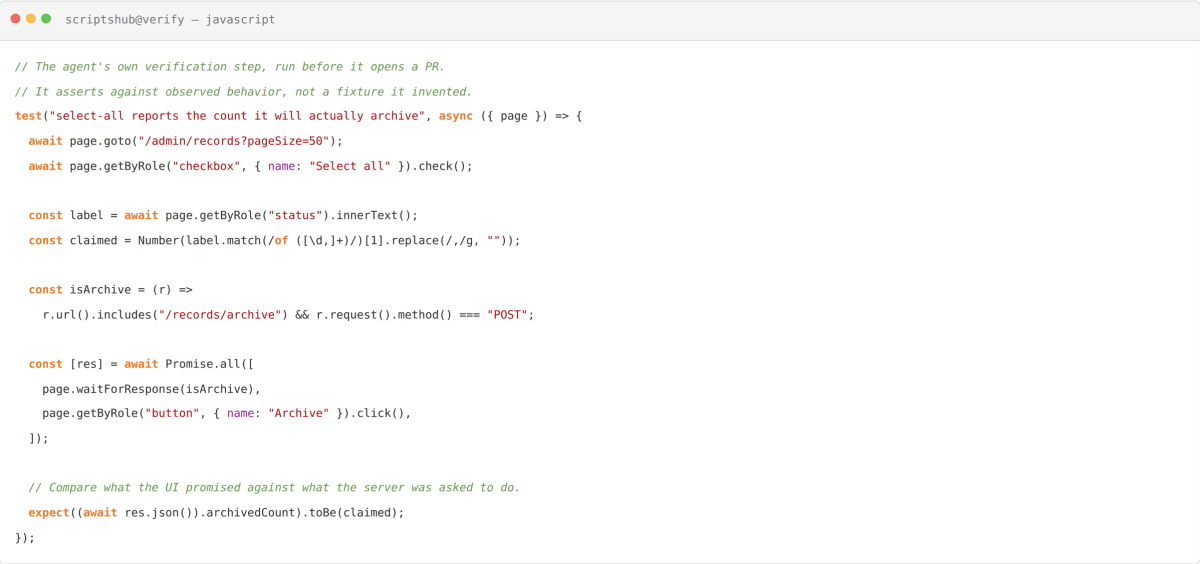
Why this works: The assertion compares two independently produced values: a number rendered by the client and a number returned by the server. Internal consistency is no longer enough to make the test pass.
How to verify it worked: Break it on purpose. Bind the handler back to the page slice while the label reads the total, and confirm the test fails. A test you cannot make fail by reintroducing the defect is not verifying anything. The same rule governs self-healing tools: heal locators, never assertions.
Pattern 2: Behavior-First Test Generation and API Contract Testing
Once the agent can observe, test generation reverses. A test written from source restates the code; in contrast, a test written from an observed session provides independent evidence, having passed through the real reducer, serializer, and database.
API contract testing covers what the browser cannot see. The OpenAPI specification is one of the few artifacts an agent cannot quietly agree with itself about, so a contract checker catches the defect class where implementation changed and specification did not, the discipline behind .NET Minimal APIs.
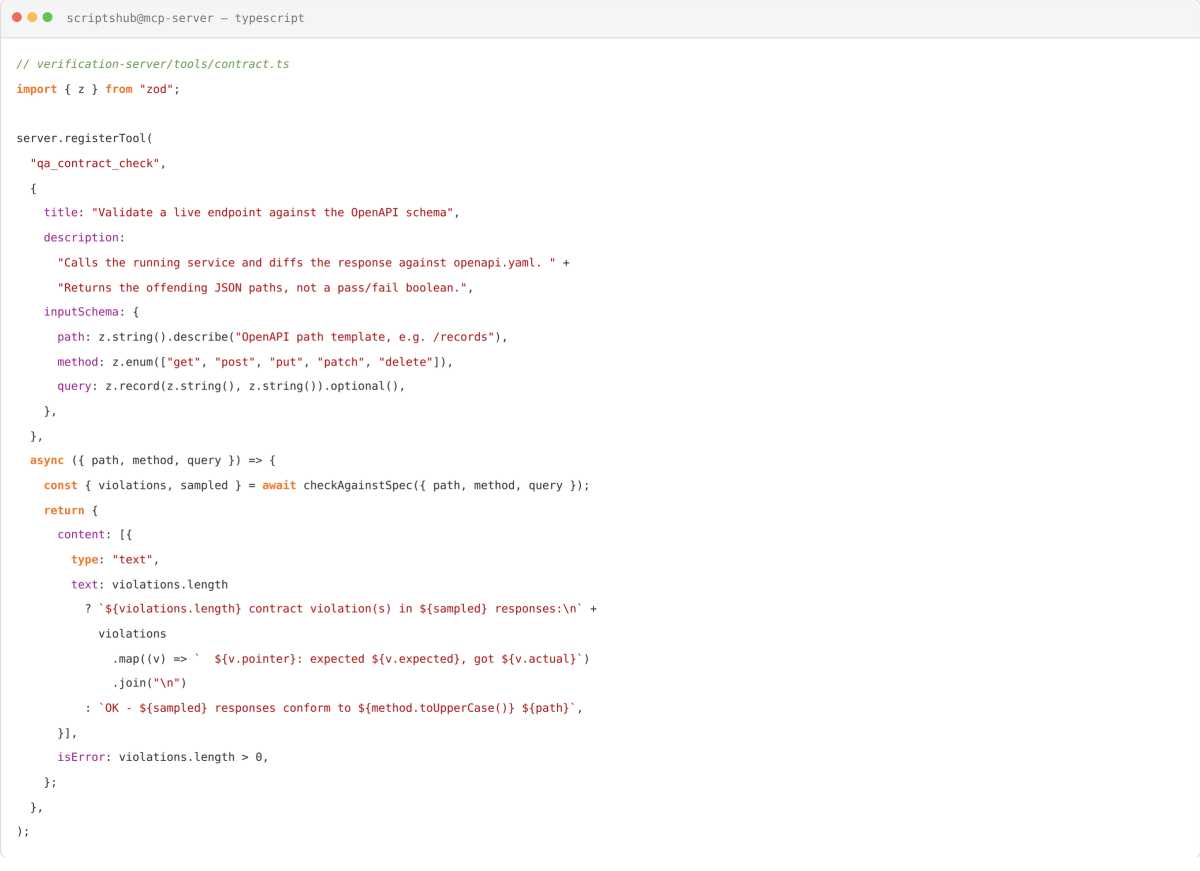
Why this works:The tool returns JSON pointers with expected and actual values rather than a boolean. An agent told “contract check failed” guesses at a fix; an agent told
/meta/totalCount: expected integer, got undefinededits the right line.
Pattern 3: Review Tools the Agent Calls Before the Pull Request
Code review is usually the last QA automation stage to move. Reviewing a finished artifact made sense when a human wrote every line; when the author revises in seconds, the queue adds hours to a one-minute fix.
Semgrep scans the agent’s diff for injection sinks and missing authorization checks. Secret detection is cheap, and a secret reaching a remote branch must be rotated. An axe-core audit catches contrast, labeling and focus-order regressions; Deque reports that automated testing covers 57% of accessibility issues by volume, against the familiar 20–30% figure, which counts WCAG success criteria.
Most QA automation teams already run these analyzers in CI. What they lack is the repair loop, because those analyzers run against a merged artifact the agent has no relationship with. We run a two-week pilot on one repository: we wire the loop, you keep the config, the same discipline as our AI consulting services and hardening a vibe-coded app.
What Does an MCP-Native QA Architecture Look Like?
Four layers: the coding agent as MCP host, thin servers for browser control, verification and review, a pinned disposable environment, and CI as gate of record.
MCP-Native QA Architecture
The agent plans, writes, calls tools, and repairs, holding no test logic of its own. However, keep the servers thin: a server deciding which failures matter judges without the context to judge. Additionally, pin the environment and make it disposable, since flaky tools train the agent to retry rather than investigate. Finally, point the browser server at localhost:3000, not staging.
The coding agent calls verification tools inside the loop

Verification runs as a tool call during development, so the agent sees the failure while the reasoning is still live.
A trimmed transcript against @playwright/mcp 0.0.79. Tool surfaces change between releases; check tools/list first.
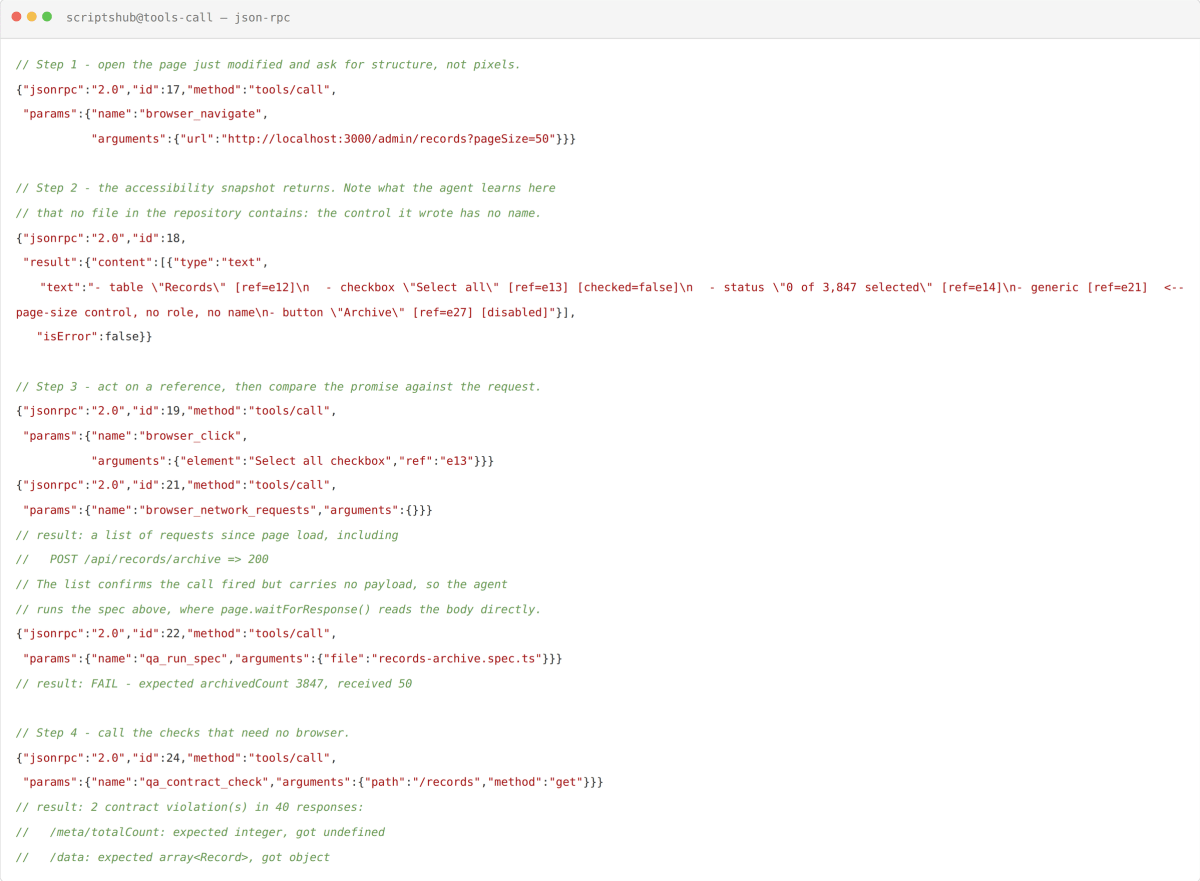
Why this works: Each step returns structured evidence into the context window that produced the change, so the agent repairs from a JSON pointer while the reasoning that caused the defect is live.
Does MCP-Native QA Replace CI in AI Software Testing?
No. CI remains the gate of record. Teams get this wrong in both directions: refusing to move verification earlier, or deleting CI checks because the agent already ran them.

The next table maps each signal to its equivalent. browser_* tools ship with the browser server; qa_* and review_* come from your own servers.

Our companion guide to MCP servers for test automation covers which servers to wire first, how to build your own, and how to secure credentials.
Where Does MCP-Native QA Pay Off Most?
On rendered surfaces and service boundaries, where a running system produces evidence the source cannot. The loop does not make the model smarter, which is where most AI software testing effort goes; it changes where the evidence comes from.
The team from the opening tracked merged pull requests needing a follow-up fix within a week. Six weeks on, that rate fell on the repositories the loop covered and held steady on their backend services. We are not publishing figures without client sign-off.
Wiring test agents into your coding loop? Two-week pilot, one repository, fixed scope. We wire the loop into the tools your coding agents already call, measure the follow-up-fix rate before and after, and hand over the config. Same QA automation discipline, no retainer. Book the pilot, or see how we approach web application development. Prefer email? info@scriptshub.net.
Frequently Asked Questions
Q. What is MCP-native QA?
MCP-native QA exposes browser automation, test generation, and contract validation to coding agents as Model Context Protocol tools. As a result, agents verify real behavior during development instead of waiting for CI.
Q. Why do AI coding agents miss regressions that tests should catch?
Because one agent writes implementation and tests from a single premise, so the tests document the misunderstanding. The agent reads the repository but never observes the running process, and CI feedback lands too late.
Q. Does MCP-native QA replace CI?
No. Development-time verification runs on a working tree against one seeded environment and acts as a filter. CI runs on the merge commit and remains the only gate that can claim anything about a release.
Q. Does MCP-native QA replace code review?
No. Review tools called during development catch mechanical defects such as injection sinks, missing labels and contract drift. Humans still review intent, design and whether the change was warranted.
Q. Which MCP servers should I wire up first?
Start with the Playwright browser server, then a thin verification server exposing your test runner and an OpenAPI contract check. QA automation review tools wrapping Semgrep and axe-core come third.
Q. Does MCP-native QA work with Claude Code, Cursor, and GitHub Copilot?
Yes. Any MCP host can call these tools, and Playwright MCP documents setup for Claude Code, Cursor, VS Code, Windsurf and Codex. Your own servers register the same way.
Q. Is it safe to give a coding agent browser and repository access?
Safe under constraints. Page content becomes model input and cannot be trusted. Therefore, point the loop at local, seeded, disposable environments. Avoid production tokens and require approval before any tool mutates real data.


