

Quick Summary
The V-JEPA world model – Meta’s Video Joint-Embedding Predictive Architecture – learns how the physical world behaves by predicting abstract representations of masked video in latent space instead of reconstructing pixels. That shift delivers roughly 1.5-6× better training efficiency and representations rich in motion and intuitive physics. Its action-conditioned variant, V-JEPA 2-AC, enables zero-shot robot control from under 62 hours of unlabeled data, and the 2026 V-JEPA 2.1 release sharpens dense features for grasping, navigation, and depth. For engineering teams, the takeaway is build-vs-adopt: evaluate a frozen V-JEPA world model encoder before committing to costly pixel-reconstruction pretraining.
If your team is weighing whether to pretrain a video model from scratch, wincing at the GPU bill for pixel-reconstruction, or trying to give a robot a sense of how objects move, you have run into the wall the whole field hit. Generative AI produces plausible pixels and fluent text, yet it remains poor at something a toddler does effortlessly: holding an internal model of how the world behaves and predicting what happens next.
At ScriptsHub Technologies, we track predictive-learning research because it keeps changing the build-versus-adopt math for the data engineering and applied-AI teams we work with across the US, UK, and India. The V-JEPA world model is the clearest example, and this guide explains what it is, how it works, and where it fits in a production stack.
What is the V-JEPA world model?
V-JEPA (Video Joint-Embedding Predictive Architecture) is a self-supervised AI model from Meta’s FAIR lab, introduced in 2024 and scaled in V-JEPA 2 (2025). Instead of generating missing pixels, the V-JEPA world model predicts abstract representations of the missing content in latent space. The guiding idea is simple but load-bearing: predict what is knowable, and abstract away what is not.
That single choice yields representations that capture motion, dynamics, and intuitive physics at far lower compute cost than pixel reconstruction – and, in V-JEPA 2, transfer zero-shot to robot manipulation. It is the most developed instance of a world model: a system that learns how an environment behaves well enough to anticipate outcomes and plan.
Why understanding the physical world is hard for AI
Most self-supervised pretraining reproduces its input at full fidelity – next-token prediction in language, masked-pixel reconstruction in vision (MAE, VideoMAE). For video that is badly posed: most pixel detail is unpredictable, so a pixel loss spends the model’s capacity on irreducible noise. The result is high training cost, slow convergence, and features that over-represent appearance and under-represent motion. Yann LeCun’s 2022 position paper put it directly: intelligence needs predictive world models at the right abstraction level, and pixel space is wrong.
Contrastive methods (SimCLR, DINO, BYOL-style) do not fix this either. They learn invariances through augmentation engineering – crops, color jitter – that encode human priors about what should not matter, and their invariance objective discards temporal information: two frames of one clip are treated as “the same thing,” the wrong bias for learning how scenes evolve. World modeling needs an objective that is predictive, latent, and self-supervised – scalable to internet video without labels. JEPA fills that gap.
The JEPA framework: prediction in representation space
A Joint-Embedding Predictive Architecture has three learned parts: a context encoder that represents a visible view, a target encoder that represents the full view, and a predictor that maps the context representation – plus a variable for what is unknown, such as which regions are masked – onto a prediction of the target representation. Crucially, the loss is a distance in embedding space, not in pixels.
Because the encoder may discard unpredictable information, training must prevent representational collapse, where everything maps to a constant. JEPA solves this asymmetrically: the target encoder receives no gradients and is an exponential moving average (EMA) of the context encoder, while the predictor is kept narrow so it cannot shortcut the problem. Why this matters: the stop-gradient target plus a bottlenecked predictor removes the need for negative-pair mining and augmentation pipelines – two of the most brittle, expensive parts of earlier self-supervised systems.
Inside the V-JEPA architecture and self-supervised training
V-JEPA operates on clips of 16-64 frames, broken into 3D spatio-temporal patches called tubelets (typically 2 frames × 16 × 16 pixels). Around 90% of each clip is masked using multi-block tube masking – the same spatial regions removed across every frame.
That detail is the engineering heart of the model. If masks varied per frame, the model could copy content from neighboring frames and learn nothing about dynamics; tube masking removes that shortcut and forces spatio-temporal reasoning. The context encoder (a Vision Transformer, ViT-L/H in V-JEPA, 1.2 billion parameters in V-JEPA 2) processes only the visible tokens – the same efficiency trick as MAE, but with no pixel decoder. A narrow predictor, conditioned on positional queries for masked locations, then predicts the target encoder’s representations under an L1 latent loss and stop-gradient. This is the feature-prediction objective: learning by predicting representations rather than pixels – the core of its self-supervised video understanding, as the original paper’s title, “Revisiting Feature Prediction,” makes explicit.

Figure 1. The V-JEPA world model in one view: the context encoder sees visible tokens, the predictor fills in masked regions, and the loss is computed against the EMA target encoder in embedding space – no pixel decoder required.
Training is fully self-supervised. V-JEPA learned from two million unlabeled videos; V-JEPA 2 scaled to over one million hours of internet video. Each step masks clips, computes the latent loss, backpropagates through the encoder and predictor, and EMA-updates the target. There is no decoder, no negative-pair mining, and no heavy augmentation – and removing those three pieces drives most of the reported 1.5-6× efficiency gain over pixel-reconstruction baselines.
What V-JEPA’s representations actually learn
The honest test is to freeze the backbone and attach attentive probes, measuring representation quality rather than fine-tuning budget. There, it was among the first video models competitive on both motion- and appearance-centric benchmarks: roughly 82% on Kinetics-400, about 72% on Something-Something-v2 (built so single-frame appearance is not enough), and around 77% on ImageNet despite never seeing a labeled image.
V-JEPA 2 pushed further, reaching 77.3 top-1 accuracy on Something-Something-v2 and state-of-the-art 39.7 recall-at-5 on Epic-Kitchens-100 action anticipation. Aligned with a language model at 8-billion-parameter scale, it set strong video-QA results (for example, 84.0 on PerceptionTest). It also did well on intuitive-physics and physical-reasoning probes that test whether a model recognizes physically impossible events – evidence that latent prediction captures an expectation over world dynamics, not just texture statistics.
Predictive vs. generative learning: the engineering trade-offs
The two paradigms are not competitors so much as tools for different jobs.

Figure 2. Generative models reconstruct pixels through a decoder; V-JEPA predicts an embedding directly, skipping the costly render step.
The table below summarizes where each one wins.
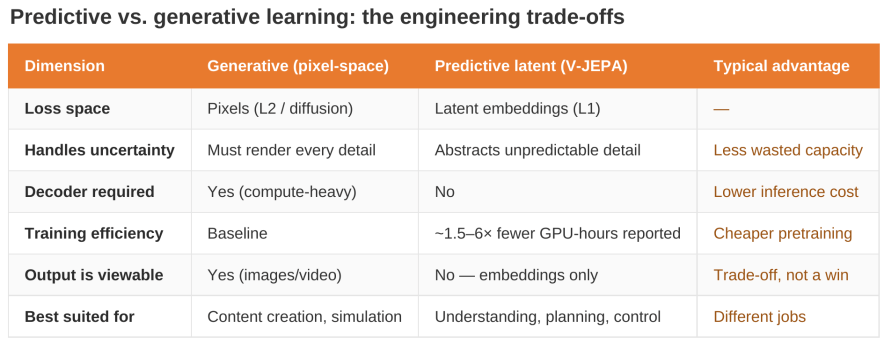
The last row is the honest limitation: a JEPA cannot show you what it expects, since its predictions live in embedding space. For media generation, generative world models with pixel output remain the right tool. But for systems that must act – robots, agents, autonomous machines – a fast, abstract predictor of consequences is what planning needs, and rendering pixels along the way is wasted computation.
If your roadmap involves video understanding, anomaly detection, or robotic perception, our AI development services team benchmarks a frozen V-JEPA world model encoder against a pixel-reconstruction baseline before you commit to a pretraining budget – an evaluation that often changes the plan.
How the V-JEPA world model powers robotics and embodied AI
V-JEPA 2’s headline result is V-JEPA 2-AC, an action-conditioned variant. Meta froze the video encoder and trained a 300-million-parameter predictor on under 62 hours of unlabeled robot interaction (the Droid dataset) to model how latent state evolves given an action.
At deployment, the robot encodes its camera view and a goal image, then runs model-predictive control in latent space: sample candidate action sequences, roll them forward through the predictor, score each by distance to the goal embedding, execute the best first action, and replan. Meta reports zero-shot pick-and-place of novel objects on Franka arms in labs it never trained in – planning in ~16 seconds per step versus minutes for diffusion-based world models, with no reward engineering, demonstrations, or environment-specific fine-tuning.

Figure 3. The planning loop runs entirely in representation space: encode, sample actions, roll forward, score against the goal embedding, execute, and replan.
The data economics are the real story. The expensive component is trained once on passive internet video; the robot-specific head needs only tens of hours of unlabeled logs. Meta frames this as a step toward advanced machine intelligence (AMI): embodied AI agents that perceive, predict, and act in the physical world. The same pattern – a pretrained latent world model plus a small action-conditioned head – is being explored for navigation, industrial inspection, ergonomics, and as the perception core for assistants that anticipate rather than describe.
What changed in V-JEPA 2 and V-JEPA 2.1
V-JEPA 2 (2025) is the 1.2-billion-parameter model that scaled the recipe to over a million hours of video and added the action-conditioned planning head. Meta released its code and checkpoints for commercial and research use, which lowers the bar to evaluation. In March 2026, V-JEPA 2.1 targeted a known weakness – balancing global motion with fine-grained local detail – via a dense predictive loss (all tokens contribute), deep self-supervision (loss applied at multiple encoder layers), and multi-modal tokenizers. The result is higher-quality, temporally consistent dense features that sharpen grasping, navigation, object-interaction prediction, and 3D depth. The latent-prediction principle holds; the spatial grounding is sharper.
Limitations and open research directions
The authors are candid about what is unsolved. Long-horizon prediction drifts past a few seconds, capping planning depth; goal specification via target images is clumsy; control is sensitive to camera pose; and the encoder’s temporal window of seconds limits hierarchical reasoning. The model also lacks persistent memory and object-centric structure – targets of hierarchical JEPA variants and memory-augmented architectures.
The benchmark picture matters too. On physics suites designed to resist shortcut learning, every current video model – V-JEPA included – still sits well below humans. “World model” today names a research trajectory, not a finished artifact.
What V-JEPA means for engineering teams
The V-JEPA world model’s real contribution is less any single benchmark than a validated design principle: predictive learning in representation space is a scalable path to machines that understand dynamics – and a foundational building block for physical AI, where systems must act, not just generate. The actionable read is build-versus-adopt. Teams building video understanding, anomaly detection, or robotic perception should evaluate a frozen, self-supervised encoder before commissioning pixel-reconstruction pretraining. Robotics groups should pilot the frozen-encoder-plus-action-head recipe, which turns world modeling from a data problem into an integration problem.
Turning a research result into production is its own discipline: encoder selection, frozen-backbone model engineering and MLOps, evaluation harnesses, and the data pipelines underneath. That is the work our AI consulting and engineering teams do. If you are scoping a video-understanding or robotics-perception build and want a clear-eyed read on whether a V-JEPA world model fits, start a conversation with our team.
Frequently Asked Questions
Q. What does V-JEPA stand for?
V-JEPA stands for Video Joint-Embedding Predictive Architecture. It is a self-supervised model from Meta’s FAIR lab that learns video representations by predicting masked content in latent space rather than reconstructing pixels.
Q. How is V-JEPA different from generative AI models?
Generative models reconstruct full-fidelity pixels and need a heavy decoder. The V-JEPA world model predicts abstract representations in embedding space, so it can ignore unpredictable detail – more efficient for understanding and planning, but it cannot produce viewable images.
Q. What is a world model in AI?
A world model is a system that learns how an environment behaves well enough to predict future states and plan actions. The V-JEPA world model is a leading example, learning intuitive physics from video to control robots.
Q. Can V-JEPA control robots?
Yes. V-JEPA 2-AC, an action-conditioned variant, performs zero-shot pick-and-place on real robot arms by planning in latent space, after training on under 62 hours of unlabeled robot interaction data.
Q. What is the difference between V-JEPA 2 and V-JEPA 2.1?
V-JEPA 2 (2025) is a 1.2-billion-parameter model that added robot planning. V-JEPA 2.1 (2026) refines the recipe with a dense predictive loss and deep self-supervision, producing sharper, temporally consistent features.
Q. Is V-JEPA open source, and can I use it commercially?
Meta released V-JEPA 2 code and checkpoints for commercial and research use, so teams can evaluate and deploy it. The original V-JEPA (2024) shipped under a non-commercial CC BY-NC license, so check the license of the checkpoint you adopt.


